

What does an SEO consultant do? An easy guide
Consultancy | SEO
Key takeaways
An SEO consultant helps a business understand what it needs to do to improve its organic search performance, why those actions matter and which ones should be prioritised first.
What does an SEO consultant have to do with a GP?
No, it isn’t the start of a terrible joke. It’s a helpful way to think about the role of a consultant within your business.
An SEO consultant helps a business understand what it needs to do to improve its organic search performance, why those actions matter and which ones should be prioritised first. Like a GP, an SEO consultant diagnoses a problem and creates a treatment plan to tackle it.
In this guide, we unpack what an SEO consultant actually does (and doesn’t) do, so you can ensure you are hiring the right SEO provider for your business and needs.
What is an SEO consultant?
An SEO consultant is a specialist who advises businesses on how to improve their visibility in organic search.
Their role is usually more strategic than purely delivery-focused.
Rather than simply being given a list of keywords and asked to “do some SEO”, a consultant should investigate questions such as:
- Which searches are genuinely valuable to the business?
- Which pages should target them?
- Why are competitors outperforming the website?
- Are technical problems holding important pages back?
- Is existing content satisfying the right search intent?
- Are multiple pages competing with each other?
- Where are the quickest realistic opportunities?
- What should the internal team work on first?
- How should SEO performance be measured?
The output should be a clearer understanding of what is happening, what needs to change and what should be prioritised.
The important distinction is that an SEO consultant does not necessarily carry out every recommendation themselves. If we go back to our example from the introduction, if you have a health concern, it’s not your GP who would issue the pills if you’re sick; you would need to visit other health professionals to undertake your treatment plan. Similarly, in the world of marketing, a business would need someone else to implement the work the SEO consultant recommended.
For this reason, consultancy is often most useful when you already have people who can implement the work within your business, such as a marketing manager, copywriter, developer or internal SEO team, but need experienced strategic guidance to make sure those resources are focused in the right places.
What is SEO consulting?
Let’s get down to the nuance.
SEO consulting is the service provided by an SEO consultant. It can range from a one-off review of a particular problem to ongoing strategic support. For example, a business might hire an SEO consultant for a short-term project, such as investigating a sudden decline in organic traffic or advice during a website migration. Or they may have a monthly retainer, allowing them to tap into the consultant’s experience and knowledge whilst they undertake their own SEO campaign.
That makes SEO consultancy particularly useful when you need expertise but do not necessarily need to outsource the entire SEO campaign.
What does an SEO consultant actually do?
The exact work depends on the business and the problem being solved, but most SEO consultancy involves some combination of the following.
1. Understand your business and commercial goals
Good SEO consultancy should begin with the business, not the keyword tool. Much like a good SEO agency, before making recommendations, a consultant needs to understand:
- What you sell.
- Who you sell it to.
- Which services are most commercially important.
- Which markets you want to grow.
- What a valuable enquiry looks like.
- How customers typically find and choose you.
- What role organic search is expected to play.
This matters because a keyword with high search volume is not automatically a good keyword.
A search generating 1,000 visits from people who will never become customers can be less valuable than a niche commercial query producing a handful of qualified enquiries.
The consultant’s job is therefore not simply to find keywords; instead it is to identify search opportunities that connect with what the business is trying to achieve.
2. Review your existing SEO performance with an SEO audit
Before recommending new activity, an SEO consultant will usually look at what is already happening. This is often presented in a report called an SEO audit. The consultant will probably look at data from:
- Google Search Console.
- Google Analytics.
- SEO platforms such as Semrush or Ahrefs.
- Website crawling tools like Screaming Frog
- and the website itself.
They may analyse things such as:
- Whether there are technical issues stopping the website from being properly crawled.
- Which pages already generate organic traffic.
- Which queries produce impressions.
- Where rankings are improving or declining.
- Which commercial pages are underperforming.
- Whether traffic is generating enquiries.
- Where competitors have stronger visibility.
- Whether there are opportunities that the website is already close to capturing.
This last point can be especially valuable because sometimes the best SEO opportunity is not a brand-new keyword; it’s a search where Google is already beginning to associate your website with the topic, but the relevant page is sitting in positions 8 – 20. A consultant can identify that momentum and recommend how to strengthen it.
Whilst an SEO audit is often part of consultancy, the two are not exactly the same thing. An audit diagnoses what is happening, but consultancy helps you decide what to do about it.
But a useful audit should not simply produce a spreadsheet containing hundreds of issues. Instead, the consultant should help distinguish between:
- Critical problems. Issues that are genuinely restricting visibility or preventing important pages from being indexed or understood.
- Warnings. Changes that are likely to improve performance.
- Low-priority issues. Technical imperfections that may be worth fixing eventually but are unlikely to materially affect commercial results.
That prioritisation is often where consultancy adds the most value, as the business will know which activity will deliver the best impact.
3. Carry out keyword and search-intent research
Keyword research is about much more than finding phrases with search volume.
A consultant should also establish why somebody is searching and what type of page Google expects to satisfy that query.
For example:
Someone searching: “what does a professional commercial cleaner do?” is probably researching the service.
Someone searching: “Commercial cleaner Birmingham” is much closer to choosing a provider.
The same type of page should not necessarily target those searches.
A consultant may group searches into categories such as:
- Informational. Looking for information about a topic. These searches are often questions or quite long.
- Commercial investigation. Asking questions that can help them choose a provider, such as “which is best, a freelancer or an agency?”
- Transactional. Searching for a specific product or service, for example “iPad”.
- Local. Looking for a local service provider.
- Navigational. Looking for a specific company or brand.
4. Map keywords to the right pages
Once the research is complete, an SEO consultant should then decide which keywords should map to:
- Service pages.
- Location pages.
- Blog articles.
- Guides.
- Comparison pages.
- Case studies.
This helps prevent a common SEO mistake: creating multiple pages that all target almost the same search intent and end up competing with each other. For example, a business might have one main commercial cleaning service page, a Birmingham location page, an office cleaning page and several informational blogs about cleaning.
Without careful planning, those pages can begin competing for the same searches.
Content mapping helps define
- The primary keyword theme for each page.
- Supporting keyword variations.
- The search intent being targeted.
- How supporting articles connect with commercial pages.
- Where internal links should point.
The aim is to create a website where each page has a clear purpose.
5. Provide technical SEO guidance
An SEO consultant does not necessarily need to be the person who makes technical changes to the website, but they should be able to diagnose technical problems and explain what needs to happen.
A consultant may then work alongside your developer to make sure fixes are implemented correctly. This can be particularly useful when the technical issue is not simply “fix this error”, but requires decisions about SEO strategy.
6. Create or review an SEO strategy
One of the most valuable things an SEO consultant can provide is a structured SEO roadmap.
That might set out:
- Which services or topics should be prioritised.
- Which commercial pages need improvement.
- Which new pages should be created.
- What supporting content is required.
- What technical problems should be addressed.
- Which internal links need adding.
- Where authority or backlinks need improving.
- How work should be sequenced.
- How success should be measured.
The keyword is prioritised. Most websites have far more potential SEO work than they have time or budget to complete. A consultant should help answer the question: What should we do first? That is often more useful than producing an enormous list of theoretically possible improvements.
7. Help with content mapping
Content mapping is an important part of SEO consultancy, particularly for websites with lots of services or existing blog content.
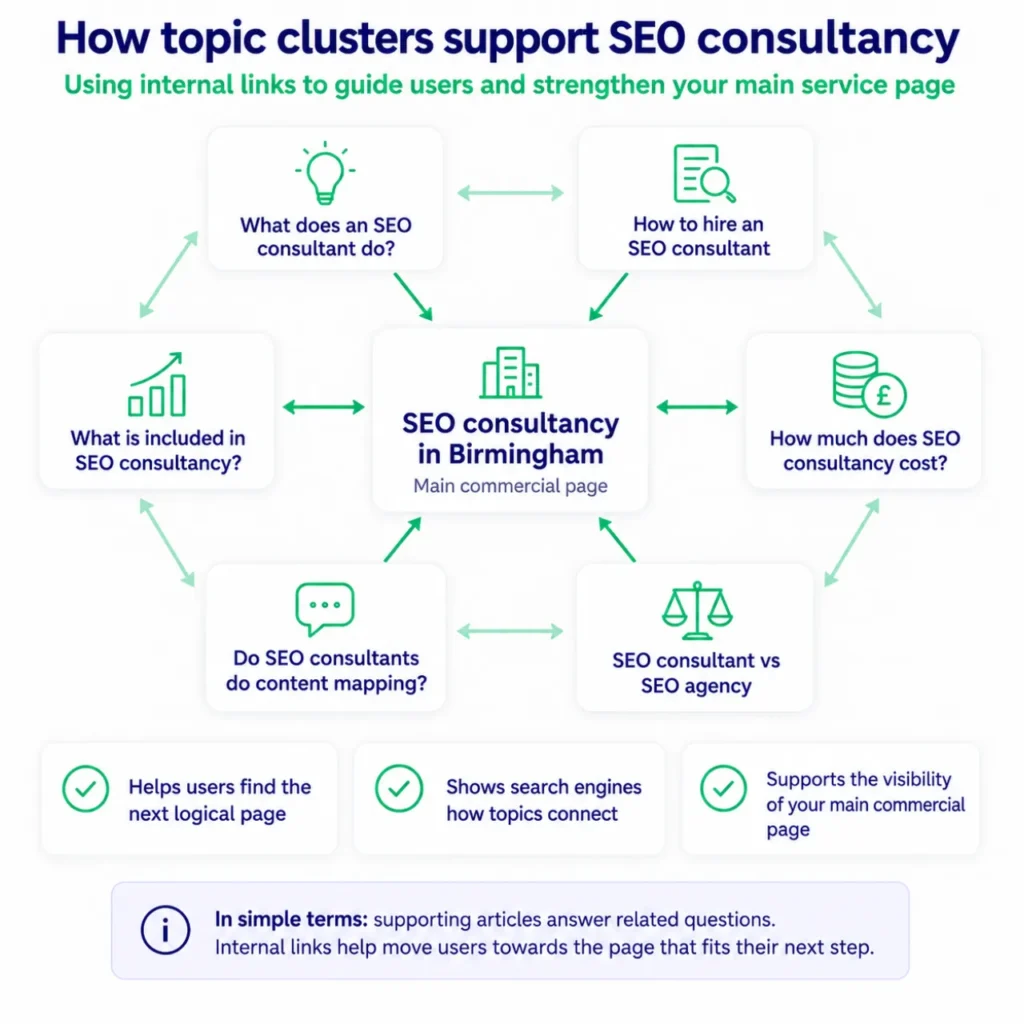
Content mapping is the process of aligning your website pages and target keywords with the specific search intent of users at every stage of their buyer’s journey. For example, instead of creating ten loosely related articles about the same topic, a consultant might recommend one strong commercial page, supported by several tightly focused informational articles with clear contextual internal links back to the commercial page.
This creates a much more coherent topic cluster that users can move along and can also help search engines understand which page is the main commercial destination.
8. Review and improve existing content
SEO consultancy should not always result in creating more content. Often, the opportunity lies in improving pages you already have. This can be a really efficient use of time – if you already have the content on your site, amending it can often take a lot less time than making loads of new content from scratch.
An SEO consultant may try to identify content that:
- Ranks on page two.
- Receives impressions but very few clicks.
- Targets the wrong intent.
- Lacks important sections.
- Is competing with another page.
- Has weak internal links.
- Has become outdated.
- Attracts traffic without generating enquiries.
The recommendation might then be to:
- Rewrite parts of the page.
- Change its keyword focus.
- Consolidate overlapping content.
- Add expert information.
- Strengthen internal links.
- Improve the title and description.
- Build supporting content around it.
That can be considerably more effective than continually publishing new articles.
9. Analyse competitors
SEO competitor research is not simply about copying what ranking websites have written. A consultant should look for patterns. For example:
- Which competitors dominate important commercial searches?
- What type of pages are Google rewarding?
- How detailed are those pages?
- What supporting content do competitors have?
- How strong are their backlink profiles?
- What topics do they cover that you do not?
- Where are their weaknesses?
- Are there searches where the competition is surprisingly poor?
The aim is to understand what it will realistically take to compete.
Sometimes competitor analysis reveals that an opportunity is much easier than expected; other times, it shows that ranking will require significantly more content, authority or investment. Both conclusions are valuable because they help you plan your subsequent SEO strategy.
10. Advise on internal linking
Internal links are so undervalued! Internal links (when you link from one page on your website to another one) are one of the strategies an SEO consultant can tell you to use to help clarify the relationship between pages on your website. They can help:
- Users find useful related information.
- Search engines discover pages.
- Distribute authority around the website.
- Establish topic relationships.
- Reinforce which pages are most important.
A consultant may create an internal linking plan showing:
- Source page.
- Destination page.
- Recommended anchor text.
- Where the link should appear.
- Why it is useful.
The strongest links are usually contextual. For example, an article discussing how to hire an SEO consultant might naturally link to an SEO consultancy service page when the reader reaches the point where they are ready to compare providers.
That is more useful than adding a random “SEO consultant Birmingham” link to every SEO article on the website! It allows the user to move to the next logical page in their customer journey. If a user is reading an educational article about “how to hire an SEO consultant”, the logical conclusion is that they’re thinking about hiring a consultant soon. The article should suggest further reading on the topic (maybe another article on “what to look for when hiring an SEO consultant”) or a commercial page that allows them to understand the company’s SEO consultancy service.
11. Work with your internal team
This is one of the main situations where SEO consultancy makes sense. You may already have a marketing manager, web developer and copywriter. What is missing is somebody who can coordinate the SEO thinking.
An SEO consultant can provide the strategy while your existing team carries out the implementation.
The workflow might look something like this:
- The marketing manager: Knows the commercial aim and explains it to the SEO consultant.
- The SEO consultant: Identifies the search opportunity for the service/product, maps the content, creates the brief and advises on internal linking.
- The copywriter: Writes the article using the brief.
- The developer: Makes technical changes, such as altering the page template to allow for additional content.
- The marketing manager: Coordinates approval and publication.
This can be more cost-effective than outsourcing an entire SEO campaign when you already have capable internal resources.
If this sounds closer to what you need than fully managed SEO, our SEO consultancy in Birmingham is designed to provide strategic support while your team retains control of implementation.
12. Monitor performance and refine the strategy
SEO consultancy is not always a one-off exercise. An ongoing consultancy retainer may allow you to regularly review:
- Rankings
- Impressions.
- Clicks.
- Conversions.
- Page-level performance.
- Competitor movement.
- Newly emerging keywords.
- Work completed by the internal team.
This allows the strategy to evolve. For example, Search Console might reveal that a page has started appearing for a valuable commercial term that was not originally a major target. Once this discovery is made, the consultant may then recommend what activity may improve the website’s visibility for that term. It might include:
- Strengthening that page.
- Expanding particular sections.
- Improving internal links.
- Creating supporting content.
- Building additional authority.
The SEO strategy should respond to evidence rather than remaining fixed for twelve months because that was what appeared in the original plan.
What doesn’t an SEO consultant usually do?
This depends on the consultant and the engagement, but consultancy is generally different from fully managed SEO. A consultant does not normally write every article, upload content, or build every backlink. That’s what the internal team does.
Instead, their role is to provide analysis, strategy, recommendations, oversight, troubleshooting and expert guidance. That distinction is important when comparing SEO services.
If you want somebody to tell your team what needs doing and help them do it well, consultancy may be the right fit. But if you want somebody to take responsibility for carrying out most of the SEO activity for you, a managed SEO service may be more appropriate.
SEO consultant vs SEO agency: what’s the difference?
There can be overlap, but the simplest distinction is:
- SEO consultant: Primarily provides expertise, strategy and guidance.
- SEO agency: Primarily provides a team that can both plan and deliver the work.
Consultancy tends to make sense when you already have implementation capacity, whereas managed SEO tends to make sense when you need external capacity as well as expertise.
Some businesses also use a hybrid model. For example, an SEO consultant may oversee the strategy while an internal marketer and external copywriter handle implementation.
The best model depends on the resources you already have.
When should you hire an SEO consultant?
SEO consultancy can be particularly useful when one (or more) of the following are true:
- You have an internal marketing team but lack specialist SEO expertise.
- Your SEO activity feels busy but unfocused.
- Organic performance has plateaued.
- You are getting traffic but not enough relevant enquiries.
- Important service pages are not gaining visibility.
- You are unsure which keywords or pages to prioritise.
- Several pages appear to be competing with each other.
- You are planning a website redesign or migration.
- You want an independent review of your current agency’s strategy.
- You need a second opinion on the state of your website’s technical SEO.
- You have plenty of ideas but need somebody to turn them into a prioritised roadmap.
The common thread is that you need clearer direction more than you need additional hands.
Do SEO consultants do content mapping?
Yes. Many SEO consultants include content mapping as part of strategy work.
Content mapping connects search demand to search intent to the right page on your website.
A consultant may create a plan showing:
- The topic.
- Target keyword.
- Search intent.
- Target URL.
- Whether the page already exists.
- Required changes.
- Supporting content.
- Internal links.
For larger websites, this can be particularly useful for preventing keyword cannibalisation and making sure new content has a clear purpose before it is written.
Does an SEO consultant write content?
Sometimes. Some consultants also provide copywriting, while others work alongside your existing writers. At Twogether Digital, we offer a flexible approach. So, you can pay for consultancy and top it up with other activities such as copywriting or link building when you need it.
But writing content is not necessarily central to consultancy; their role tends to focus on the strategy side, whilst copywriting would be handled internally by the organisation’s team.
Does an SEO consultant make technical changes?
Again, it depends on the engagement.
Some SEO consultants are comfortable making technical changes themselves. Others diagnose the issue and work with a web developer who implements the fix. At Twogether Digital, we have a web development team, so we are able to handle technical issues when needed.
How is SEO consultancy different from an SEO audit?
If we go back to our medical analogy, an SEO audit acts like a GP’s diagnosis when you have a health problem. An SEO audit usually tells you what’s wrong, whereas an SEO consultancy is broader; it tells you what to do next – the treatment plan and prognosis, if you will.
An audit may tell you: “These are the problems and opportunities we’ve identified.” Whereas consultancy should also help answer: “Which of these matter most, what should we do first, how should we implement them, and what should we do next?”
That ongoing interpretation and prioritisation can make consultancy particularly valuable when a business has already collected lots of SEO data but is unsure what action to take.
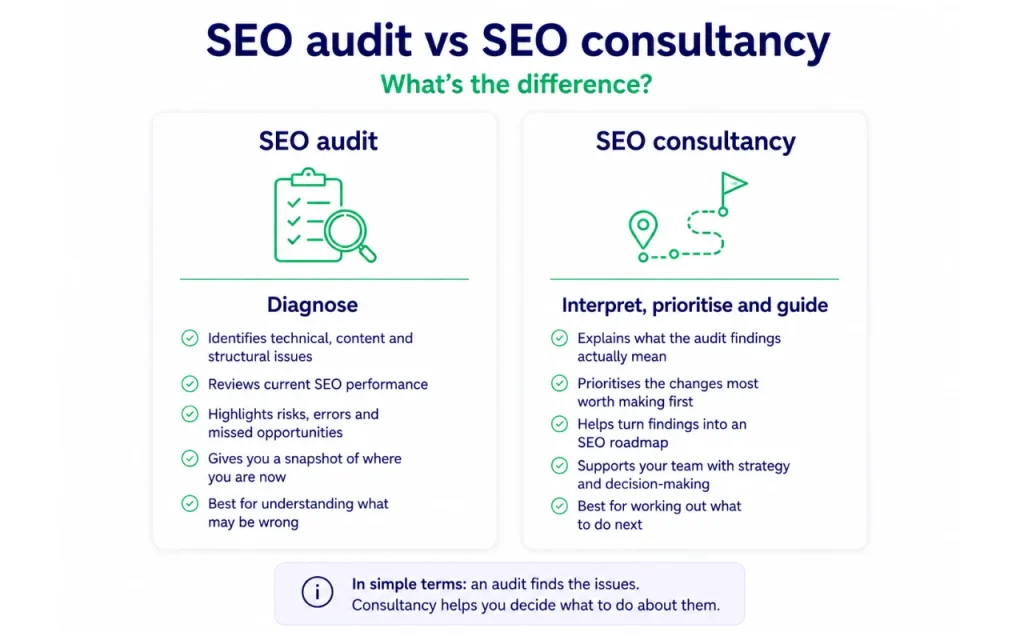
We unpack this difference in more detail in our guide SEO audit vs SEO consultancy.
Do you need ongoing SEO consultancy?
Not always. A one-off consultancy project can work well when you need:
- An audit.
- A strategy.
- A second opinion.
- Keyword mapping.
- Migration advice.
- Help solving a defined problem.
Ongoing consultancy can make more sense when your internal team is continually publishing content, updating the website or working across several SEO priorities. In that situation, regular consultant input can help keep the strategy focused and adapt it as new data emerges.
What should you expect from a good SEO consultant?
A useful consultant should leave you with greater clarity.
You should come away from a project understanding:
- What is currently happening.
- What the biggest opportunities are.
- Which problems actually matter.
- What should be prioritised.
- Who needs to do what.
- How you will know whether the strategy is working.
You should not finish a consultancy engagement with a 100-page audit and no idea where to start. The value an SEO consultant can bring lies in turning SEO information into decisions.
Do you need SEO consultancy or fully managed SEO?
It can be tricky to weigh things up. A simple way to decide is to look at your internal resources.
If you have people who can write, edit the website, implement development changes and publish content but need somebody to provide the specialist SEO direction, consultancy can be a very good fit.
If you do not have those resources internally and want a provider to plan and deliver the campaign, managed SEO may make more sense.
Neither approach is inherently better.
The right one depends on where the skills and capacity already sit within your business.
Looking for an SEO consultant in Birmingham?
If you have the internal resources to implement SEO but need experienced help deciding what to prioritise, where the opportunities are and how the different pieces should fit together, consultancy may be more appropriate than outsourcing an entire campaign.
Twogether Digital provides SEO consultancy in Birmingham for businesses that need strategic guidance, performance analysis, keyword and content planning, technical advice and a clearer roadmap for organic growth.
We can work alongside your existing marketing team, writers and developers, helping you focus their time on the SEO activity most likely to make a meaningful difference.