

SEO audit vs SEO consultancy: What’s the difference?
Consultancy
Key takeaways
An SEO audit identifies what’s wrong with your website, whereas SEO consultancy helps you decide what to do about it. An audit is primarily diagnostic, while consultancy focuses on interpreting the findings, prioritising actions and turning them into a practical SEO strategy or roadmap.
In many ways, we can answer this question very quickly. An SEO audit can tell you what’s wrong with your website, whereas SEO consultancy helps you work out what to do about it.
That might sound like a small distinction, but it matters.
A good SEO audit can uncover technical problems, content gaps, weak internal linking, keyword issues and plenty of other things that may be holding your website back.
But the problem is that an audit can also leave you with a very long list. A 70-page report isn’t much use if nobody can tell you which five things actually deserve your attention first!
That’s where SEO consultancy comes in. If an audit is like getting blood test results at the GP, then consultancy is the work the doctor will do to put a recovery plan in place.
The impact of not understanding the difference between an audit and consultancy can mean you spend money on getting a diagnosis without the much-needed treatment plan.
Let’s look at the two before explaining the difference in detail.
What is an SEO audit?
An SEO audit is a review of your website’s current organic search performance.
The aim is to identify issues that may be making it harder for search engines to crawl, understand or rank your website.
Depending on the site, an audit might look at:
- Technical SEO.
- Crawling and indexing.
- Canonical tags.
- Redirects and broken links.
- Page speed and Core Web Vitals.
- Website structure.
- Internal linking.
- Metadata.
- Keyword targeting.
- Search intent.
- Duplicate or competing pages.
- Content quality.
- Backlinks.
- Organic search performance.
The result should give you a clearer picture of what is working, what isn’t and where opportunities may exist.
At least, that’s the idea.
An SEO audit should be more than a list of errors
SEO tools are very good at finding things, but they are slightly less good at deciding whether those things actually matter!
Run almost any established website through an SEO crawler, and you’ll get warnings…lots of them.
Some will be important, and some could probably sit there happily for another five years without causing you any meaningful problems. I often find myself telling clients “This looks really bad, but only about three of these warnings actually matter.”
That’s why we don’t believe the aim of an SEO audit should be to make every dashboard turn green.
Instead, the aim should be to understand which issues are genuinely affecting your ability to attract the right people from search.
A warning about a missing image attribute probably shouldn’t be treated with the same urgency as Google being unable to index your most important commercial page. As in most disciplines, the context matters.
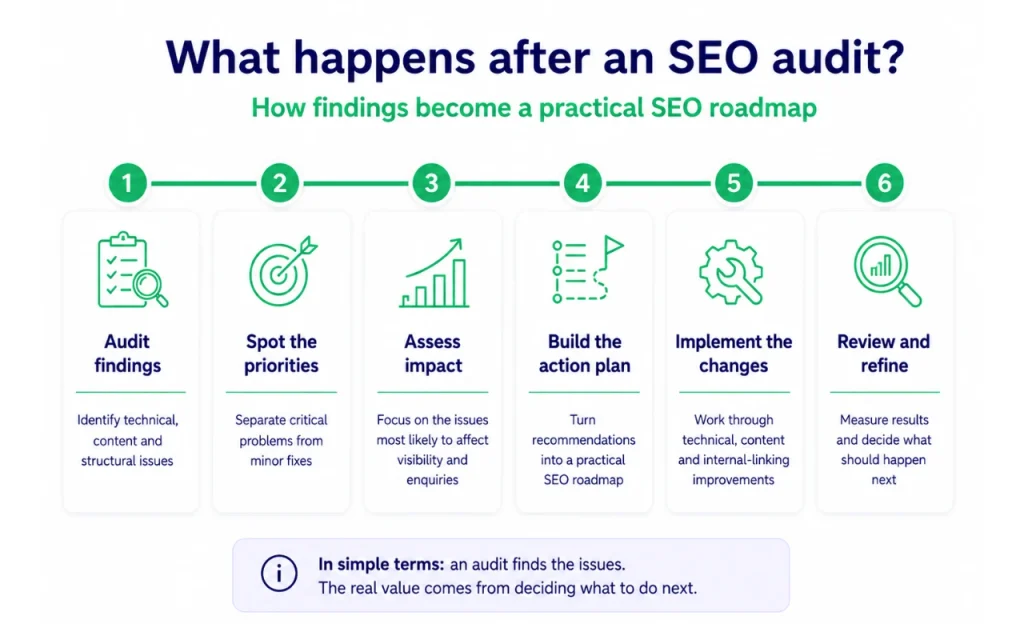
What happens after an SEO audit?
This is where businesses can get stuck.
You receive the report with a spreadsheet full of recommendations.
Everybody who’s anybody in your business agrees that something should probably happen. And then…
Not much does.
Usually because nobody is quite sure where to start!
The first step after an audit should be to turn the findings into a prioritised action plan.
That means looking at each recommendation and asking questions such as:
- How much impact could this have?
- Is it affecting one page or the whole website?
- Does it affect an important commercial page?
- How confident are we that fixing it will help?
- How difficult is it to implement?
- Does it need a developer?
- Does it need new content?
- Is there something else we should fix first?
That process is just as important as finding the issue in the first place.
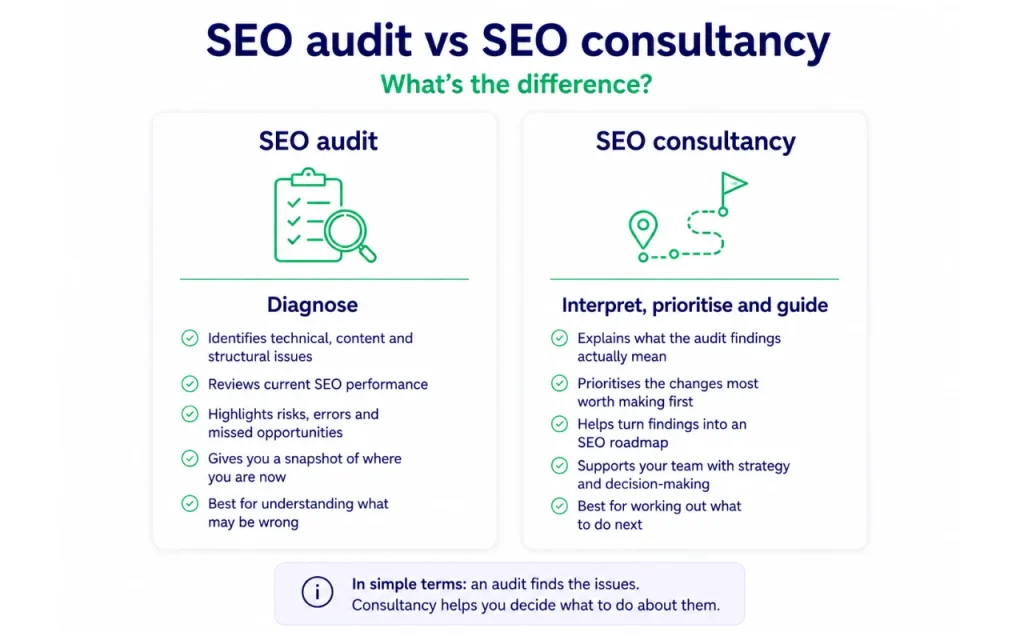
SEO audit vs SEO consultancy: what’s the difference?
The easiest way to think about it is:
An SEO audit diagnoses the problems, SEO consultancy helps you decide what to do next.
An audit usually gives you a snapshot of your current situation, whereas consultancy is more ongoing and strategic.
An SEO consultant may take the findings from an audit and help you:
- Prioritise recommendations.
- Decide which issues are worth fixing.
- Turn findings into an SEO roadmap.
- Brief developers.
- Plan new pages.
- Improve existing content.
- Resolve keyword cannibalisation.
- Map keywords to the right URLs.
- Develop an internal linking strategy.
- Review performance after changes have been made.
- Decide what the next priority should be.
In other words, consultancy turns information into decisions.
Do you always need SEO consultancy after an audit?
Not always. Some businesses already have enough SEO expertise internally to interpret the findings and implement them.
If your marketing team knows what needs to happen, your developers understand the recommendations, and everyone agrees on the priorities, you may be perfectly capable of taking things forward yourself.
Consultancy becomes more useful when the difficult part isn’t identifying the problems, but deciding what they mean.
For example, you may know that several pages are ranking for similar keywords. But should you merge them? Rewrite one? Leave them alone?
There often isn’t a single automatic answer. It’s in these situations that experience and context become valuable.
When might you need an SEO consultant?
There are a few situations where an SEO consultant can be particularly useful after an audit.
1. You have a long list of recommendations but no clear priorities
This is probably the most common one.
If everything is labelled “high priority”, nothing is really high priority. A consultant can help you separate:
- Urgent problems.
- Quick wins.
- Longer-term opportunities.
- Nice-to-have improvements.
That makes the workload much more manageable.
2. Your technical team needs clearer instructions
SEO recommendations often sound straightforward until somebody has to implement them. “Improve crawlability” isn’t much of a development brief.
A consultant can translate SEO findings into practical actions that your developer can actually work with.
3. Your content isn’t performing
An audit may identify weak pages, thin content or poor keyword targeting, but improving them requires more than increasing word count. You may need to reconsider:
- Search intent.
- Page structure.
- Keyword targeting.
- Supporting content.
- Internal links.
- Where the page sits within the wider customer journey.
An SEO consultant can help map that out.
4. Your service pages aren’t ranking for commercial searches
You may be getting impressions and traffic, but not for the searches that are likely to generate enquiries. That can indicate a wider issue with:
- Keyword targeting.
- Page roles.
- Search intent.
- Internal linking.
- Topical authority.
- Website architecture.
An audit can help uncover the problems, then consultancy can help decide how to implement changes to get back on track.
5. Your rankings have dropped, and there isn’t an obvious cause
Ranking drops can happen for plenty of reasons.
A competitor may have improved, Google may be interpreting the query differently, your page may have become less relevant or a technical change may have caused problems.
Or nothing dramatic may have happened at all.
This is where blindly following an audit checklist can cause more harm than good; you need to understand the wider context before making changes.
Can an SEO audit become an SEO strategy?
It can contribute to one, but they aren’t the same thing.
An audit mainly looks at where you are now, whereas an SEO strategy looks at where you want to go.
A broader SEO strategy may include:
- Commercial objectives.
- Keyword research.
- Search-intent analysis.
- Competitor research.
- Page mapping.
- Content planning.
- Technical improvements.
- Internal linking.
- Authority building.
- Measurement.
- Prioritisation.
An audit is useful because it shows you the current weaknesses and opportunities, but a strategy should connect those findings to the commercial goals of the business.
Otherwise you risk spending months improving things that were never particularly important in the first place.
What should a good post-audit action plan look like?
We generally prefer action plans that are clear enough for somebody to actually use.
Each recommendation should ideally explain:
- What is the issue? What have we found?
- Why does it matter? How could it affect organic search performance or the user journey?
- What needs to happen? What practical change are we recommending?
- Who needs to do it? Marketing, development, copywriting or somebody else?
- How important is it? What deserves attention now, and what can wait?
A simple framework can often work better than an enormous technical report, because ultimately the value isn’t in how many problems you find but in how many useful improvements actually get made.
Should you fix every issue in an SEO audit?
Probably not, at least not immediately.
SEO is full of opportunities to spend time fixing things that have very little impact. Adding a few alt texts just because an audit says they are missing is very rarely going to move the needle when your bottom-of-the-funnel service pages are not optimised for commercial intent keywords!
That doesn’t mean technical quality doesn’t matter.
It means priorities should be based on the likely effect on the website, not simply on whether a tool has flagged something.
We’d usually give more attention to an issue affecting:
- Crawling.
- Indexing.
- Important commercial pages.
- Search intent.
- Duplicate targeting.
- Website structure.
- Internal linking.
- User experience
…than a minor issue sitting on a low-value page that receives almost no organic traffic.
The right answer depends on the website (which, inconveniently, is why there isn’t a universal SEO checklist that solves everything!)
What if your SEO audit has identified hundreds of problems?
Don’t panic, and don’t immediately start fixing them in the order they appear in the spreadsheet.
First group them and look for patterns.
You may find that 150 individual warnings actually come from one template issue or that dozens of pages are affected by the same internal-linking problem.
Once you understand the underlying cause, the problem often becomes much easier to manage.
SEO consultancy can help turn an audit into a roadmap
If you’ve already completed an SEO audit but aren’t sure what to do with the findings, you may not need another audit; you may need somebody to help you interpret it.
Our SEO consultancy in Birmingham is designed for businesses that already have some marketing or implementation resource but want specialist SEO support to guide the work.
We can review your existing audit, sense-check the recommendations, identify the priorities and help turn everything into a practical plan.
That might mean working with your marketing team, briefing your developer, planning content or simply giving you an independent second opinion before you invest more time and budget.
The goal isn’t to give you another report, it’s to help you decide what should actually happen next.
Frequently asked questions
Do I need an SEO audit before hiring an SEO consultant?
Not necessarily. A consultant may recommend an audit if there isn’t enough information to understand the problem, but if you already have reliable SEO data, an existing audit or a specific issue you want help with, consultancy can start from there.
Can an SEO consultant review an audit completed by another agency?
Yes. An independent review can be useful if you want a second opinion on the recommendations, priorities or proposed work. They should let you know if the existing audit does not have the information they need to build a roadmap to fix the errors the audit uncovered.
What happens if an SEO audit finds technical problems?
Some issues may require development work. An SEO consultant can help explain what needs to change, why it matters and how urgently it should be addressed. They should be able to work with your web development to implement the changes.
How often should you carry out an SEO audit?
There isn’t one fixed timetable. Large or frequently changing websites may need more regular reviews, while smaller sites may only need a detailed audit when performance changes, the website is being rebuilt, or a strategic review is required.
Can an SEO consultant help implement the recommendations?
That depends on the consultancy arrangement. Some consultants provide strategic advice only, while others can also support implementation, content planning, optimisation or coordination with developers. At Twogether Digital, we can handle all of it.
Got an SEO audit but not sure what to do next?
If your audit has left you with more questions than answers, that isn’t unusual.
We can help you turn the findings into something more useful.
Our SEO consultancy in Birmingham gives you access to specialist SEO support without requiring you to hand over the entire campaign.
We’ll help you work out what matters, what can wait and what is most likely to make a genuine difference.