

How to measure the ROI of B2B SEO
SEO
Key takeaways
Measuring the ROI of B2B SEO is not always straightforward because business buyers rarely convert after one website visit. That means businesses need to look beyond rankings and traffic.
To do this properly, businesses need clear goals, reliable tracking, useful form data, GA4 and CRM integration, and a consistent process for recording what happens after an enquiry is made.
Attribution will never be perfect, but the aim is not mathematical certainty. It is to build a clear, honest and commercially useful picture of whether SEO is helping the right people find, trust and eventually buy from your business.
“Is our SEO campaign actually making us any money?”
It is a fair question.
After all, rankings are nice. Traffic graphs moving upwards are encouraging. More people finding your website is usually a good thing.
But none of those things pays the bills on their own.
For a B2B business, the real question is whether SEO is helping the right people discover your company, make an enquiry and move into your sales pipeline.
That can be harder to measure than it sounds.
A consumer might click on a product, add it to their basket and buy it within five minutes. The whole journey can often be tracked in one session.
Whereas a B2B buyer may first find one of your articles, return three weeks later to read a service page, share a case study with a colleague, follow you on LinkedIn and finally get in touch several months later.
Which activity deserves the credit?
The honest answer is usually: more than one (and that’s why a joined-up approach to digital marketing is important).
But that does not mean measuring B2B SEO ROI is impossible.
In this guide, we will explain how to measure B2B SEO ROI in a way that is commercially useful, without pretending every journey can be tracked perfectly.
What does ROI mean in B2B SEO?
ROI stands for return on investment (but you already know that!). In simple terms, it compares what you gained with what you spent.
For an SEO campaign, the calculation might look like this:

Let’s talk through the example above:
Imagine you invest £12,000 in SEO over a year; during that period, organic search contributed £30,000 in new revenue. The calculation would be:
(£30,000 – £12,000) ÷ £12,000 × 100 = 150% ROI
That means the campaign generated a return of 150% above the original investment. Simple enough. The difficult part is deciding which revenue SEO genuinely contributed to – that is where B2B measurement becomes more complicated.
Why B2B SEO ROI is harder to measure
A B2B sale rarely happens after one website visit.
This is how a regular B2B customer journey may go:

It’s long! With lots of steps! What is more, several people are involved (and I’m sure we’ve all had experiences of how long “decision by committee” can take). The person who first discovers your website may not be the person who submits the enquiry. In fact, the person who signs the contract may never visit the website at all!
This creates three main challenges.
1. Long sales cycles
Because the sales cycle is so long, there will most likely be a significant delay between the first organic visit and the final sale. So, if you only measure revenue generated during the first three months of a campaign, you may miss opportunities that are still moving through the pipeline.
2. Multiple touchpoints
Organic search may introduce the prospect, but LinkedIn, email, referrals, PPC or direct visits may also influence the decision. So, whatever is tracked as the final conversion source does not always tell the full story. This can skew your perception of how much your SEO is contributing to revenue.
It’s one of the key reasons why we advocate a joined-up approach to digital marketing, and why we always consider the quality of your brand, website design, and other digital touchpoints (for example, how your company utilises third-party platforms like LinkedIn and Reddit) whenever determining why your website is not generating enough conversions.
3. Incomplete data
Website analytics may show that someone completed a form. It probably won’t tell you whether the enquiry was a good fit or what happened after the form was submitted. It also can’t say whether the deal was won or how long the prospect remained a client. To measure ROI properly, marketing and sales data need to work together.
One of the easiest ways to do this is to train your sales team to ask “How did you first discover [insert your brand name]?”
I have seen some very clever companies even use their sales team to find out which search term they used to find them, so that they could compare the enquiry with the query data in Google Search Console. This allowed them to link the search term the prospect used with the revenue generated and even determine which page led to the enquiry! Now that’s a great way to calculate the ROI of specific SEO activities.
4. Traffic is not the same as commercial value
One of the easiest mistakes to make is to assume that more organic traffic means better SEO performance.
Sometimes it does, but not always.
Imagine that your website traffic increases by 80% – that sounds excellent.
But what if most of the increase comes from:
- Job seekers, not prospective clients.
- Students looking for apprenticeship opportunities, not prospective clients.
- People outside your service area.
- Consumers when you sell to businesses.
- Broad informational searches with no commercial relevance.
- People looking for free advice.
The traffic graph may look impressive, while the sales team sees no meaningful difference.
Now imagine a second campaign.
Traffic increases by only 15%, but visits to your key service pages rise, and you receive six enquiries from suitable organisations.
The second campaign is probably creating more value.
This is why we always recommend separating overall traffic from commercially relevant traffic.
You need to ask:
- Which pages are attracting visitors?
- What were those people searching for?
- Are they viewing priority services?
- Are they taking meaningful actions?
- Are the enquiries suitable?
- Are those enquiries entering the pipeline?
Qualified traffic matters more than raw volume.
How to measure the ROI of B2B SEO
1. Start by agreeing on what success looks like
Before measuring ROI, you need to define the result the campaign is supposed to create.
“More traffic” is too vague.
A better goal might be “Generate more employee enquiries” or “Increase enquiries for our deep cleaning service”
This helps you define what a qualified lead is.
For example, if you’re a commercial cleaning company, you may only offer office cleaning within a clearly defined geographical area. Lead from outside that area won’t count as “qualified”.
Your goal can then be fleshed out to “Generate more enquiries for office cleaning services in Worcestershire”. That’s nice and specific and can help a B2B SEO service provider tailor the campaign so that you’re (hopefully) getting the type of enquiries that you want.
2. Decide what counts as a meaningful enquiry
This will change based on your business and industry. It could be a demo booking, a meeting booking, a quote request or a file download! It really depends on what counts as an “enquiry” that your sales team can work with to nurture interest into action!
A recruitment agency may want phone calls, meeting bookings and CV applications all tracked. A manufacturer may just want discovery calls booked. Whatever the activity that counts as an “enquiry” to your business, explain it to your SEO provider.
3. Understand which B2B SEO metrics actually matter
Once you’ve identified your goals and what counts as an enquiry and a qualified lead, your B2B SEO service provider should be able to determine what data will indicate that the campaign is making progress.
There is no single metric that tells you whether SEO is working. A useful measurement framework includes both early indicators and commercial outcomes.
Early indicators
Early indicators help show whether visibility is moving in the right direction; they matter because revenue often takes longer to appear.
- Relevant search impressions: Impressions show how often your website appears in search results. An increase suggests that Google is beginning to associate your pages with more searches. However, relevance matters. An increase in impressions for your key services is more useful than growth around unrelated terms.
- Keyword positions. Rankings help show whether priority pages are becoming more visible, but you do not need to track every slight keyword variation. Focus on terms connected to priority services, commercial problems, important sectors, relevant locations and buyer questions. Rankings should be treated as indicators rather than the final result. For example, position three is only useful if the keyword attracts the right audience.
- Non-branded organic traffic. Branded traffic comes from people already searching for your company by name, whereas non-branded traffic comes from searches related to your services, problems or expertise. Growth in relevant non-branded traffic can show that SEO is helping new audiences discover the business.
- Visits to commercial pages. A broad increase in blog traffic may or may not support sales. Visits to service pages, sector pages, pricing content and case studies are often more commercially meaningful. Track how many people reach these pages and what they do next using a service such as Google Analytics.
- Click-through rate. Click-through rate shows how often people click your result after seeing it. A page can rank well but still attract very few visits if the title and description do not match the searcher’s needs. Improving click-through rates can sometimes generate more traffic without improving rankings.
- Engagement with useful content. Engagement data should be treated carefully. A long time on page does not automatically mean someone is a strong prospect. However, useful signals may include viewing several related pages, moving from an article to a service page, reading a relevant case study or downloading a resource. These actions suggest that the visitor is exploring the business more seriously.
Commercial outcomes
Early indicators help explain progress, but commercial outcomes show whether that progress is creating value.
- Enquiries. Track the number of enquiries generated through organic search. This may include completed contact forms, phone calls, email clicks, meeting bookings or demo requests. But do not stop at the total; you also need to consider the quality.
- Qualified enquiries. A qualified enquiry comes from an organisation that could realistically become a suitable client. This is where feedback from the sales team becomes essential. Marketing analytics may record ten leads, but sales may know that only three were genuine opportunities. This is why we always insist on a face-to-face meeting regularly throughout our campaigns. We need to know whether the leads that you are getting are the ones that you want. If they’re not, we need to adjust the campaign accordingly.
- High-intent contact booked. Depending on your industry, you may have a commercial outcome that shows a higher level of intent but isn’t quite an enquiry yet. Examples include discovery calls, consultations and demo bookings.
- Opportunities created. A lead becomes an opportunity when there is a realistic chance of winning work. This is often recorded in a CRM system. Tracking opportunities helps you move beyond website conversions and understand whether SEO is feeding the sales pipeline.
- Proposal value. Proposal value can provide an early indication of commercial potential before deals are closed. For example, organic search may generate five enquiries. Three progress to qualified opportunities. Then, two of these move to the proposal stage. Together, these proposals are worth £40,000. Each enquiry may be worth approximately £20,000 (so, £100,000 in this worked example), but the actual proposal value of your marketing efforts is less. Even if the final sales have not yet closed, the campaign is clearly contributing to the pipeline.
- Closed revenue. Closed revenue is the strongest commercial measure; it tells you how much confirmed business can be connected to organic search. Where possible, distinguish between:
- First-year revenue.
- Total contract value.
- Gross revenue.
- Gross profit.
- Client lifetime value.
- Client lifetime value. Some B2B relationships continue for several years. If a client first discovers you through SEO and remains with the business for three years, the value of that original enquiry may be far greater than the first invoice suggests. Lifetime value can make SEO particularly valuable for businesses with retainers, recurring work, renewals and cross-selling opportunities.
4. Track where enquiries come from
Most businesses are able to see how many enquiries they get by counting the number of form submissions they get in their inbox, or the number of phone calls they get. It’s ok to do this manually when you’re a sole trader or micro business – there are only a few people involved in the business, so it’s less likely you’ll miss anything.
But the larger your business grows, the more people are involved. And this can lead to challenges – forgotten phone conversations, missed emails – the list can go on.
Plus, simply counting how many you’ve had doesn’t give you much information about how people actually found you.
Collect your data with Google Analytics
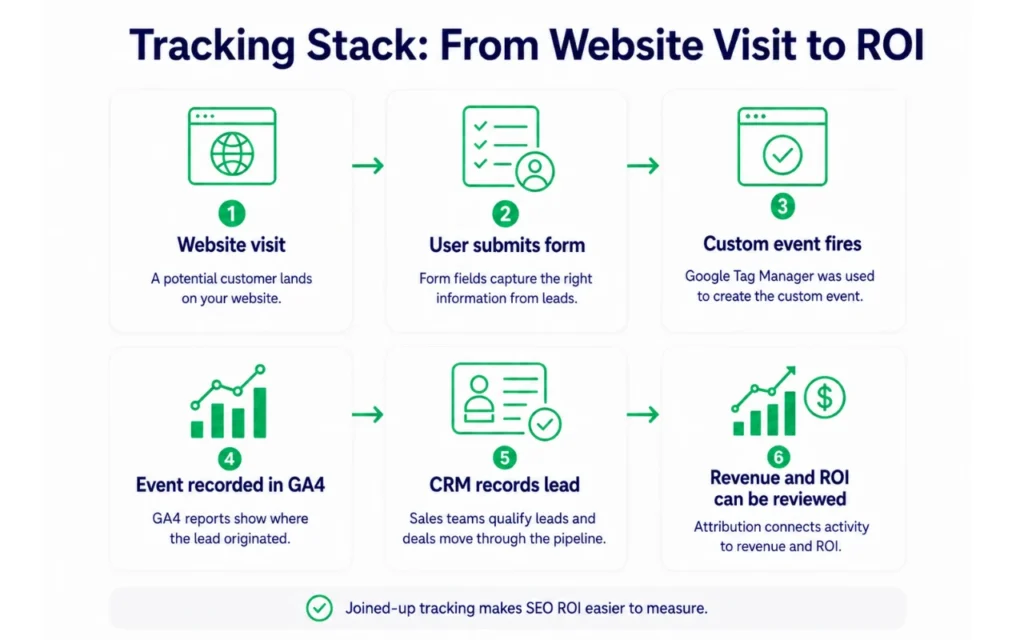
A simple way to get information on where your enquiries are coming from is to ask an agency or web developer to add a Google Tag to your website. This is a bit of code that allows you to collect data about how people are using your website in Google Analytics (GA4).
GA4 allows you to see information such as how much traffic your website gets, where the traffic comes from (e.g. Google or LinkedIn) and what your website users do when they visit your website.
But GA4 on its own won’t let you see whether an enquiry has been made. To ensure you get this type of information, you need to use a program called Google Tag Manager to create the Google Tag.
Google Tag Manager lets you create “custom events”. These are little bits of code that help GA4 track exciting things like phone clicks, email clicks and successful enquiry form submissions. The Google Tag will then send this information to GA4. Here you can create reports that allow you to count the number of enquiries, where they come from and what website pages are involved in nurturing these leads.
Connect marketing with sales with a CRM
To reduce the risk of enquiries going missing, you can also invest in a CRM. These pieces of software help companies track and manage enquiries, ensuring nothing goes missing.
A CRM is incredibly valuable to any business! Whilst GA4 can show how people found you and which actions they took on your website, your CRM can show what happened afterwards.
If you connect the two, you get a much clearer picture of what’s going on!
Use contact form fields strategically
Your website’s enquiry form can be really helpful for tracking where enquiries come from. We recommend that your website’s contact or enquiry form include fields for:
- Contact name.
- Contact details.
- Company name.
- Service requested (or a field for them to add the details of their query).
Although it’s tempting to add loads of fields to get loads of preparatory information, we recommend keeping it to a maximum of four fields. If the form takes too long to complete, or requires the user to answer tricky questions, it can put people off from completing it. Four fields will give you enough information for your sales team to respond efficiently, without creating too much friction for your users.
Then, you can use hidden fields on your website enquiry form or tracking parameters to capture information such as:
- Landing page.
- Campaign.
- Source.
- Medium.
- Original referrer.
All this information can be sent to your CRM. Once this happens, you can connect the enquiry to the source and webpage that generated it.
Then, in the CRM, once the lead is created, your team add in:
- Lead quality.
- Opportunity status.
- Proposal value.
- Closed revenue.
Data collection can be simple
You do not necessarily need a complex enterprise system to get some really good information about where your enquiries come from; a well-maintained spreadsheet can be better than an expensive CRM nobody uses properly. We often recommend this for small and micro businesses that have smaller budgets and don’t want to invest in CRM software at their current business stage.
But, regardless of what method you use to record information, the most important thing is consistency. Your sales team (or the business owner) should record where leads came from and what happened to them.
5. Understand the limits of attribution
Once you’ve got your data, you can “attribute” each enquiry to a different marketing channel. Attribution is the process of deciding which channel deserves credit for a conversion.
There are several common models.
- First-click attribution: The first channel that introduced the prospect receives the credit. This is useful when you want to understand discovery. For example, someone may first find you through a blog that they found on Google.
- Last-click attribution: The final channel before the conversion receives the credit. Although this is easy to understand, it can undervalue earlier touchpoints. If a prospect first discovers you through SEO and later returns directly to submit the enquiry, a last-click report may record that as direct traffic, rather than organic traffic and your SEO efforts won’t be given the credit they deserve.
- Linear attribution: Each recorded touchpoint receives an equal share of the credit. This recognises that several channels may have contributed; however, it assumes that every interaction had the same influence.
- Position-based attribution: With this model, more credit is given to the first and final interactions, with the remaining value shared between the middle touchpoints. This can reflect the importance of both discovery and conversion.
- Data-driven attribution: The platform uses available data to estimate which interactions were most influential. This can be useful, but the logic may not always be visible, and the data may still be incomplete.

As you can see, most attribution models have their strengths and weaknesses.
Which attribution model should a B2B business use?
There is no perfect model.
For many small and medium-sized B2B businesses, the most practical approach is to look at the data from several different perspectives.
Ask:
- Which channel first introduced the prospect?
- Which channel generated the recorded enquiry?
- Which pages did the prospect use?
- Did organic search assist the journey?
- What does the sales team remember?
- Was there a referral or offline influence?
You are looking for a reasonable picture, not mathematical perfection!
So, once you’ve got your data and can see which enquiries came from organic search engines (and therefore are due to your SEO campaign), how can you work out the ROI?
6. Work out your ROI
Let’s take a worked example. Imagine a consultancy invests £1,700 per month in SEO. Over 12 months, the total SEO investment is:
£1,700 × 12 = £20,400
During the same period, organic search generates:
- 24 recorded enquiries.
- 12 qualified leads.
- 7 sales opportunities.
- 5 proposals.
- 3 new clients.
The three new clients generate £45,000 in first-year revenue.
The simple ROI calculation would be:
(£45,000 – £20,400) ÷ £20,400 × 100 = 120.6%
The SEO campaign therefore produced a first-year ROI of approximately 121%.

But that figure still needs context. You should also ask:
- Are there open opportunities still in the pipeline?
- Will the clients renew?
- What is the profit margin?
- Did SEO assist other sales?
- Did the website improvements support PPC, email or referrals?
- Will the content continue generating leads next year?
Because SEO assets can continue producing value after the original work is complete, a one-year calculation is useful, but not necessarily the whole story.
7. Measure the cost per qualified lead
ROI is important, but cost per qualified lead can provide a clearer operational measure. The formula is:
Cost per qualified lead = SEO investment ÷ Number of qualified organic leads
Using the example above:
£20,400 ÷ 12 = £1,700 per qualified lead
Is that good? Maybe.
It depends on:
- Average client value.
- Close rate.
- Profit margin.
- Lifetime value.
- Cost of leads from other channels.
If the average client is worth £20,000, a £1,700 qualified lead may be attractive. If the average client is worth £1,800, it probably is not. SEO metrics only make sense in the context of the business model.
But once you’ve got all these figures, there are some other things to consider when judging the overall value of your SEO campaign, too.
Compare SEO with other lead sources
SEO does not operate in isolation. In fact, your pipeline may be on shaky ground if you’re only relying on one marketing channel.
Compare the value of your SEO campaign with your other marketing channels, for example, networking, email marketing and PPC. For each source, run the same calculations as you have for your SEO campaign. Consider how many leads are converting, the average client value of those leads, and the lifetime value.
SEO may take longer to produce leads than paid advertising, but its cost per lead may improve over time as established pages continue attracting visitors. Whereas paid campaigns can generate faster demand, visibility normally stops when the budget stops.
This does not mean one is always better; SEO and PPC can work extremely well together.
The important thing is understanding the role each channel plays.
Do not ignore assisted conversions
An assisted conversion happens when a channel contributes to the journey without generating the final recorded action.
For example:
- A prospect finds your website through a Google search.
- They read an article and leave.
- They later see a LinkedIn post.
- They return directly and book a call.
Organic search introduced the business, LinkedIn reinforced the message, and the direct visit generated the recorded conversion. All three played a role.
Judging ROI too soon: A common B2B SEO measurement mistake
If you’ve done your calculations and determined that your SEO campaign is not contributing enough value, don’t rush to cancel your retainer. A negative ROI does not automatically mean the campaign should stop immediately. There can be lots of valid possible reasons:
- The campaign is still too new.
- Sales opportunities remain open.
- The website is not converting (so it’s being found, but the design and structure are putting people off).
- Tracking is incomplete.
- Implementation has been delayed.
- The offer is unclear.
- Competition is stronger than expected.
- The sales team is not following up effectively.
None of these is an SEO problem. They’re website, sales or tracking problems.
SEO should not continue indefinitely without commercial justification, but it should not be judged using incomplete data or an unrealistic timescale either.
Measuring B2B SEO ROI: It can be a bit complicated!
Whilst there is a simple formula that allows you to calculate the ROI of your SEO campaign, the nature of the B2B customer journey can make direct attribution quite challenging. It’s also easy to be distracted by vanity metrics such as traffic, rather than focus on what really matters – conversions.
But you can take steps to ensure you can make sense of the data.
Begin with the commercial goal, track how the right people discover and use the website. Then, measure the number of enquiries, but separate suitable opportunities from irrelevant contacts. Once this is done, ensure that the website data is connected with your sales process. Finally, compare the revenue and pipeline influenced by SEO with the amount invested. This will help you determine the ROI of your B2B SEO campaign.
Do not expect perfect attribution, but aim instead for a clear, honest and commercially useful picture.
Learn more about how we connect SEO activity with meaningful business growth through our SEO services for B2B businesses.
Good SEO reporting should ultimately help you decide whether organic search is contributing to the pipeline, not simply whether rankings have moved. That commercial focus is built into the way we run campaigns as a Birmingham SEO agency, with strategy and reporting tied back to the enquiries and opportunities the business actually wants to generate.