

How long does B2B SEO take to generate enquiries?
SEO
Key takeaways
B2B SEO does not produce rankings, traffic, enquiries and revenue all at once. Each stage takes time, and the gap between them depends on the state of your website, competition, authority, investment and sales cycle.
The first three months are usually focused on research, technical fixes, tracking and content foundations. Between months four and six, visibility and traffic should begin to improve. More consistent enquiries and commercial results often take six to twelve months or longer.
Early progress should be measured through relevant impressions, keyword movement, non-branded traffic and visits to important service pages. Over time, the focus should shift towards qualified enquiries, opportunities, pipeline and revenue.
Most importantly, SEO should be judged by whether it helps more of the right people find and trust your business, not by traffic alone.
How long does SEO take?
This, or variations on it, is one of the first questions most businesses ask whenever I chat to them.
And it is completely understandable.
If you are investing time and money into your website, you want to know when that investment might start producing something useful. Will you see results in a few weeks? Will it take six months? Could you still be waiting a year from now? When you are needed enquiries quickly, it’s always at the forefront of your mind.
The honest answer is that there is no single B2B SEO timeline that applies to every business. Some improvements can happen relatively quickly, whereas others take much longer.
And there is an important difference between:
- Seeing a ranking improve.
- Receiving more website traffic.
- Generating an enquiry.
- Turning that enquiry into a client.
Those things do not always happen at the same time.
For a specialist B2B business, the sales process may take weeks or months after someone first finds the website.
So, how long does B2B SEO take to generate enquiries?
In many cases, you may begin to see early signs of progress within the first three months. More meaningful visibility and enquiries often take six months or longer. But that depends on where you are starting, what your competitors are doing and how much work can be completed.
Let’s break it down properly.
Why is there no universal SEO timeline?
It would be lovely if SEO worked like switching on a light.
You make a few changes, publish an article, and enquiries start arriving the following morning. Ooh, wouldn’t that be marvellous?!
Unfortunately, it does not usually work that way.
SEO involves improving your website, building useful content and earning enough trust and authority to compete with other businesses in the search results. This all takes time.
Plus, every website begins from a different position; one business may already have:
- A technically healthy website.
- Strong service pages.
- Relevant backlinks.
- Plenty of useful content.
- A recognised brand.
- Good conversion tracking.
Another may have:
- A slow website.
- Very little content.
- Confusing messaging that does not clearly articulate the benefit of the brand’s services.
- Weak authority.
- Poor internal linking.
- No clear calls to action.
- No idea which enquiries came from Google.
Those two businesses should not expect SEO to “work” equally quickly.
The market matters too.
A local consultancy targeting a small number of specialist terms may gain visibility more quickly than a national company competing for highly valuable searches against large, established brands.
So when someone promises that SEO will work within a fixed number of weeks, be cautious! They do not yet know enough about your website, market or competition to make that promise honestly.
What happens during the first 90 days?
The first three months are often about understanding the situation and putting the right foundations in place. This stage may not always produce a dramatic jump in enquiries, but it is usually where the work needed for future growth begins.
Month one: research and diagnosis
The first month should help answer questions such as:
- What does the business want to achieve?
- Which services are most commercially important?
- Who are the ideal clients?
- What are those people searching for?
- Which competitors currently appear?
- What is helping or limiting the website?
- Which pages already perform well?
- Where are the biggest gaps?
This may involve:
- An SEO audit.
- Keyword research.
- Competitor analysis.
- Search-intent research.
- Analytics reviews.
- Website structure reviews.
- Conversion tracking checks.
Some improvements may happen immediately.
For example, fixing an indexing problem or improving a page that already ranks reasonably well can sometimes produce movement quickly, but the main purpose of this stage is to avoid rushing into the wrong activity. There is little value in publishing large amounts of content before you understand what the website actually needs.
Month two: fixing foundations
The next stage may focus on technical and structural improvements.
This could include:
- Fixing broken links.
- Improving page titles and metadata.
- Resolving indexing issues.
- Improving page speed.
- Strengthening internal links.
- Updating navigation.
- Improving service-page structure.
- Removing or consolidating duplicate content.
- Setting up better tracking.
This is also when priority pages may begin to be rewritten or expanded.
Again, you may see early improvements, but some of the most important work is not immediately visible to visitors. A clearer website structure, stronger internal linking and better tracking may not feel exciting. They do, however, make the rest of the campaign much more effective.
Month three: building momentum
By the third month, the campaign should be moving from research and repair into more active growth.
That might include:
- Publishing new service pages.
- Creating supporting articles.
- Improving existing content.
- Adding case studies.
- Building relevant backlinks.
- Beginning digital PR activity.
- Strengthening calls to action.
- Monitoring early keyword movement.
At this point, you may begin to see:
- More impressions in Google Search Console.
- Improved rankings for some terms.
- Increased traffic to priority pages.
- More relevant search queries.
- Better engagement with content.
You may also receive enquiries, but it is still too early to judge the whole campaign purely by sales.
What might happen between months four and six?
This is often when the work begins to feel more visible.
Search engines have had time to discover and reassess updated pages, new content has had time to be indexed, and internal links are beginning to strengthen important areas of the website. Authority-building activity may also be starting to have an effect.
During this period, you may see:
- More keywords entering the search results.
- Existing rankings moving upwards.
- Growth in non-branded search traffic.
- Increased visibility for service-related terms.
- More visits to commercial pages.
- Early organic enquiries.
This is also when patterns start to become clearer. You may discover that:
- Certain topics attract the right visitors.
- Some pages rank but do not convert.
- Particular services have stronger demand.
- Some keywords attract unsuitable enquiries.
- A competitor is harder to displace than expected.
- A new content opportunity has appeared.
A good SEO strategy should respond to this information; it should not remain fixed simply because the original plan said to publish certain articles. The data should shape what happens next.
When should B2B enquiries start to appear?
This is the part everyone really wants to know.
And the answer is: they can appear at any stage.
A business might receive an enquiry very early if an important page was already close to ranking, a technical issue was blocking visibility, or the website had untapped authority, amongst other reasons.
For one of our clients in the oil and gas industry, a poorly optimised Google Business Profile was preventing local prospects from finding them online. Some careful, but relatively fast adjustments meant that they received an enquiry within a week of the activity taking place. It’s certainly one of the fastest impacts I have seen.
But for many B2B companies, enquiries take longer.
That is because B2B searches often sit within a much longer buying journey.
Someone might:
- Find an article while researching a problem.
- Return a month later to read a service page.
- Share a case study with a colleague.
- Compare several suppliers.
- Discuss the budget internally.
- Contact you weeks or months later.
The SEO activity may have started the relationship long before the enquiry appears.
This is also why it is dangerous to judge success using only last-click data (e.g. claiming that a lead is due to your SEO when you can trace it directly from Google Search in a tool like Google Analytics). This is because a prospect may discover you through one channel, but enquire through another.
For example, a prospect may have searched for your service and clicked through from organic search before connecting with you on LinkedIn. They then make contact several weeks later after seeing a post you did. Your tracking tool may say that this enquiry came from LinkedIn, but the first time the prospect discovered you was due to your SEO. In this example, SEO played a vital role.
Rankings, traffic and revenue do not move together
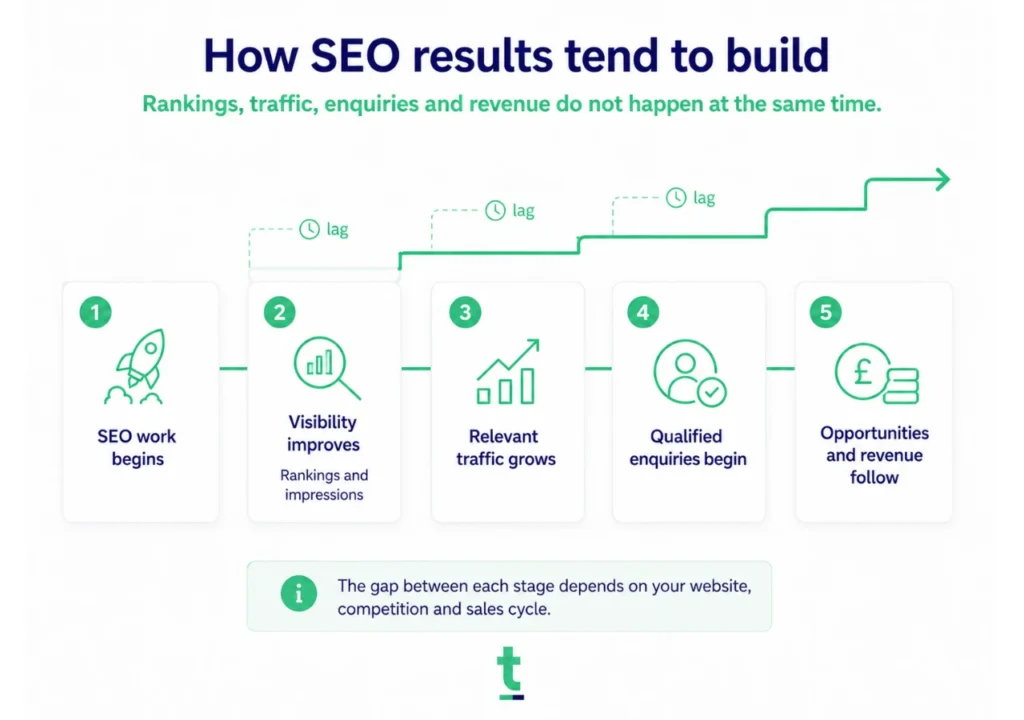
Rankings, traffic, enquiries and revenue do not happen at the same time during an SEO campaign. To track the progress of your SEO campaign, it might help to think about progress in stages, with a lag inbetween.
Stage one: visibility
The first sign of progress is often increased visibility. This means that your pages begin appearing for more relevant searches, and it may show up as:
- More impressions (this means the number of times a page is shown in the top 100 results).
- New keyword rankings (this means that the website starts appearing for new keywords that it never did before).
- Better average positions (this means that individual pages are, on average, appearing higher in the results than they were before).
- More non-branded visibility (this means you are seeing increased impressions for non-branded keywords).
Stage two: traffic
As rankings improve, more people may begin visiting the website.
But not all traffic is useful. The important question is whether the right pages are attracting the right people.
For example, an increase in visits to a broad informational article may be less valuable than a smaller increase in visits to a key service page. However, if that informational page is linked to a commercial page that is getting more visits as a consequence, then you are on to a winner.
Stage three: enquiries
Once the right visitors reach the website, the page still needs to persuade them to take action.
That depends on:
- Clear messaging.
- Strong calls to action.
- Relevant case studies.
- Trust signals.
- Useful information.
- A good user experience.
- The right offer.
SEO can bring people to the website, but the website still needs to do its job. This is why we believe in joined-up digital marketing. If your SEO has helped you grow your visibility, then your website needs to be working hard to show people the right information to persuade them to make an enquiry. Our KnowShowGrow framework summarises our joined-up approach.
Stage four: opportunities and sales
An enquiry is not the same as revenue.
The sales team may need to qualify the lead, arrange meetings, prepare a proposal and wait for internal approval. For some businesses, that process takes days. For others, it takes months.
This means an SEO campaign can be generating value before the final sale appears in the report.
What affects how quickly B2B SEO works?
Several factors influence the timeline.
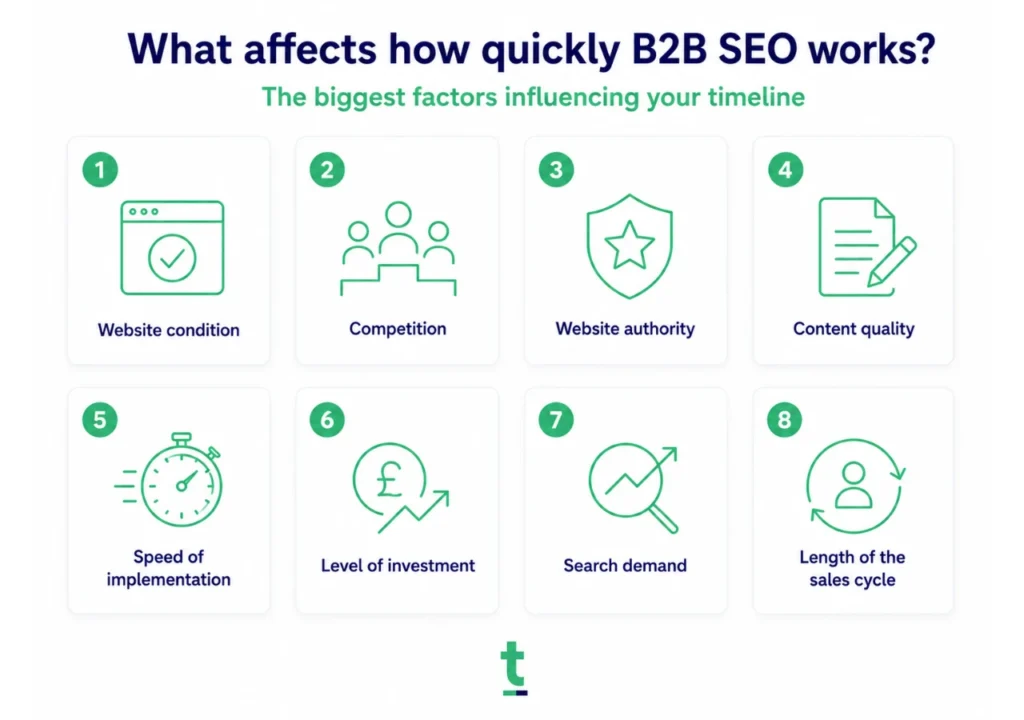
1. The current condition of your website
A healthy website can move forward more quickly. If your website already has clear service pages, good technical foundations, relevant authority and strong conversion paths the campaign may be able to focus on growth sooner.
If the website needs major restructuring, the early months may be spent fixing problems first. Don’t think of this as wasted time, it is often essential as building more content on top of a weak foundation can create more work later.
2. Your competition
You are not trying to rank in an empty search result. Other businesses are already there and some may have been investing in SEO for years. They may have large content libraries, established backlink profiles and dedicated internal teams that are working on the website’s SEO every working day.
The stronger the competition, the more time and resources it may take to close the gap, and this is especially true for nationally competitive B2B services.
3. The authority of your website
This is a big one. Search engines are more likely to trust websites that have built a strong reputation over time. Simply put, search engines tend to measure the authority of a website based on the number of links it attracts from reputable sites, especially reputable websites that are within the same industry as the target site. It takes a long time to attract and build those kind of connections.
A well-known business with an under-optimised website may be able to make progress more quickly if their website authority is already high. A newer or less established website may need more time to build that trust.
4. The quality of your content
Publishing more content does not automatically produce faster results. A large number of shallow articles may achieve very little.
Good B2B content needs to:
- Match real search intent.
- Demonstrate genuine expertise.
- Answer useful questions.
- Support commercial pages through strategic internal linking.
- Be accurate and specific.
- Give the reader a clear next step (called a Call To Action).
Content that could belong to any business is unlikely to build much trust. The strongest content usually involves your own experience, opinions, data and examples.
5. How quickly work is implemented
This is a major factor that is often overlooked. We’ve personally seen brands struggle to gain traction online because the approval process is taking too long. Sometimes this is because “too many cooks” are involved, sometimes its because the marketing managers’ workload is too high.
An agency may identify important changes within the first month, but if the changes take six months to approve and implement, the SEO results will also be delayed. Progress is usually faster when:
- Decision-makers are available.
- Content approvals are efficient.
- Developers can make changes promptly.
- Subject-matter experts contribute.
- The business can provide case studies.
- Tracking access is available.
SEO works best as a collaborative process. The agency cannot create strong results entirely on its own if important information or approvals remain stuck internally.
How much input does a B2B SEO campaign need from your team?
SEO is not usually something an agency can deliver effectively in isolation.
The agency can research keywords, improve pages, identify technical issues and create content, but the strongest B2B campaigns also rely on knowledge and decisions from inside the client’s business.
That input does not need to consume large amounts of time every week, but it does need to be available when required.
Your team may need to contribute:
- Commercial priorities.
- Information about the services you most want to grow.
- Access to subject-matter experts.
- Real customer questions and objections.
- Case studies and examples.
- Technical checks.
- Content approvals.
- Website or CRM access.
- Feedback on lead quality.
- Sales insight.
For example, an agency may identify a strong opportunity to build a new commercial page around one of your services.
To create that page properly, it may need to understand:
- Who normally buys the service.
- What problems trigger an enquiry.
- Which alternatives prospects compare.
- What questions usually arise during sales conversations.
- What makes your approach different.
- Which proof points can be shared publicly.
Without that input, the agency has to rely more heavily on assumptions and secondary research.
That can slow the work down or produce content that is technically optimised but commercially weak.
Subject-matter experts can make SEO faster, not slower
It can feel counterintuitive to involve busy specialists in marketing activity.
However, a focused 30- to 45-minute interview can often give a writer enough insight to create a much stronger article or service page than hours of generic online research.
Expert input can reveal:
- Industry terminology.
- Common misconceptions.
- Real buying objections.
- Practical examples.
- Technical nuances.
- Strong opinions.
- Useful comparisons.
- Questions prospects actually ask.
This helps the agency create content that is more specific, credible and difficult for competitors to copy.
The important thing is to make the process efficient.
A good SEO partner should tell you what input is needed, who needs to provide it and when. The agency should then take responsibility for turning that information into usable work rather than repeatedly handing unfinished tasks back to your team.
Our managed B2B SEO service is designed to combine this internal expertise with ongoing strategy, content, technical SEO and implementation.
If you already have marketers, writers or developers who can implement the work, our SEO consultancy service may provide a more appropriate level of strategic support.
6. Your level of investment
A larger budget does not allow you to bypass time, but it can allow more work to happen at once.
For example, a smaller campaign may focus on:
- One technical priority.
- Two pieces of content.
- A small amount of authority building.
A larger campaign may be able to:
- Improve several service pages.
- Publish multiple supporting articles.
- Run digital PR.
- Build links.
- Fix technical issues.
- Improve conversion paths.
Both approaches can be valid. A larger campaign simply has more capacity to progress several priorities at once.
That may help a business close competitive gaps more quickly, but it does not remove the time needed for search engines to reassess pages, authority to build or prospective clients to move through the buying journey. For a more detailed explanation, read our guide to how much B2B SEO services cost in the UK.
7. Your sales cycle
A recruitment agency may generate and close an enquiry relatively quickly, whereas a business selling a large technology platform or complex consultancy project may have a much longer process. This means the website can be performing well before the final revenue appears. You should therefore measure both marketing progress and sales outcomes.
What should you measure during the early months?
If revenue is the only thing you measure, the first few months can feel frustrating. That does not mean you should ignore commercial results; instead, it means you also need to look for evidence that the campaign is moving towards them.

The purpose of SEO is not to collect rankings, it is to support business growth, but there needs to be enough patience to allow the earlier stages to develop.
Can anything speed up the process?
There are no guaranteed shortcuts, but some things can help.
Start with clear priorities
Trying to improve every service, page and keyword at once can spread the budget too thinly.
It is often better to focus first on:
- The most valuable services
- The strongest commercial opportunities
- Pages already close to ranking
- High-impact technical issues
- Content with clear buyer intent
A focused start can produce useful learning and early wins.
Use the expertise within your business
Your team already knows things that competitors may not.
Expert interviews can help create stronger content more quickly.
They can uncover:
- Real client questions
- Common mistakes
- Useful examples
- Sector-specific insight
- Strong opinions
- Original evidence
This gives your content more substance and makes it harder to copy.
Improve the website as well as the rankings
SEO and conversion should work together.
There is little value in moving a page from position eight to position three if the page still fails to explain the service properly.
Improving messaging, trust and calls to action can help you gain more value from the traffic you already receive.
Make implementation easier
Agree responsibilities early.
Be clear about:
- Who approves content
- Who provides expert input
- Who makes website changes
- How quickly feedback is needed
- Which data should be shared
This prevents useful work from sitting in a queue for months.
Stay consistent
SEO is rarely won through one perfect article.
It is usually the result of steady, connected improvements over time.
That means:
- Updating important pages
- Creating useful supporting content
- Building relevant authority
- Reviewing performance
- Responding to new opportunities
- Improving what already exists
Consistency is often more valuable than short bursts of activity followed by long gaps.
When should you worry that SEO is not working?
SEO takes time, but that should not become an excuse for poor performance or a lack of transparency.
After a few months, your agency should be able to explain:
- What has been completed
- What has changed
- What the data shows
- What is improving
- What is not working
- What the next priorities are
If you are wondering whether the SEO is working or not, before deciding, ask whether the agreed work is actually being completed.
A strategy may be sound but still underperform if:
- New pages remain unapproved for months.
- Developers have not implemented technical changes.
- Subject-matter experts are unavailable.
- Important case studies cannot be published.
- The agency is waiting for access to key systems.
- Internal priorities repeatedly change.
The agency should make these dependencies visible rather than allowing delays to disappear inside a monthly report.
You should be concerned if:
- Nothing appears to have been implemented
- Reports only show broad traffic figures
- The agency cannot explain the strategy
- Content is being published without a clear purpose
- Traffic increases but enquiry quality falls
- The same work is reported every month
- You are discouraged from asking questions
- Results are always promised “next month”
Not every campaign will progress perfectly.
Some pages underperform. Some ideas need to change. Some competitors are harder to beat than expected.
That is normal.
What matters is whether the work is thoughtful, transparent and responsive. If you are evaluating whether an SEO provider is managing those responsibilities properly, our guide to choosing a B2B SEO agency includes the questions and warning signs to look for.
Is a three-month SEO campaign enough?
Three months can be useful.
It may be enough to:
- Complete research
- Fix important technical issues
- Improve priority pages
- Create a content plan
- Begin publishing content
- Establish tracking
- Identify early opportunities
It is less likely to show the full impact of SEO.
This is particularly true when:
- The website has weak foundations
- Competition is strong
- The business has little authority
- The sales cycle is long
- Several stakeholders influence the decision
A three-month project can create a strong starting point.
But meaningful visibility and enquiry growth often require a longer commitment.
Is six months enough?
Six months is often enough to see whether the campaign is building momentum.
By that point, you should usually have a clearer view of:
- Ranking improvements
- Traffic quality
- Content performance
- Service-page visibility
- Enquiry patterns
- Competitor movement
- The next best opportunities
Some businesses may already be generating clear commercial results.
Others may still be in the growth stage, particularly in competitive markets.
The important thing is that the campaign should now be producing useful evidence.
What about twelve months?
Twelve months gives a much better view of long-term performance.
It allows time to:
- Build a substantial content base
- Earn stronger authority
- Improve several areas of the website
- Learn from the data
- Update underperforming content
- Track longer sales journeys
- Compare year-on-year results
For many B2B companies, twelve months is a more realistic period for judging the full commercial effect.
That does not mean you should wait a year before expecting accountability.
You should still receive clear progress updates throughout.
A realistic B2B SEO timeline
A typical campaign might look something like this:
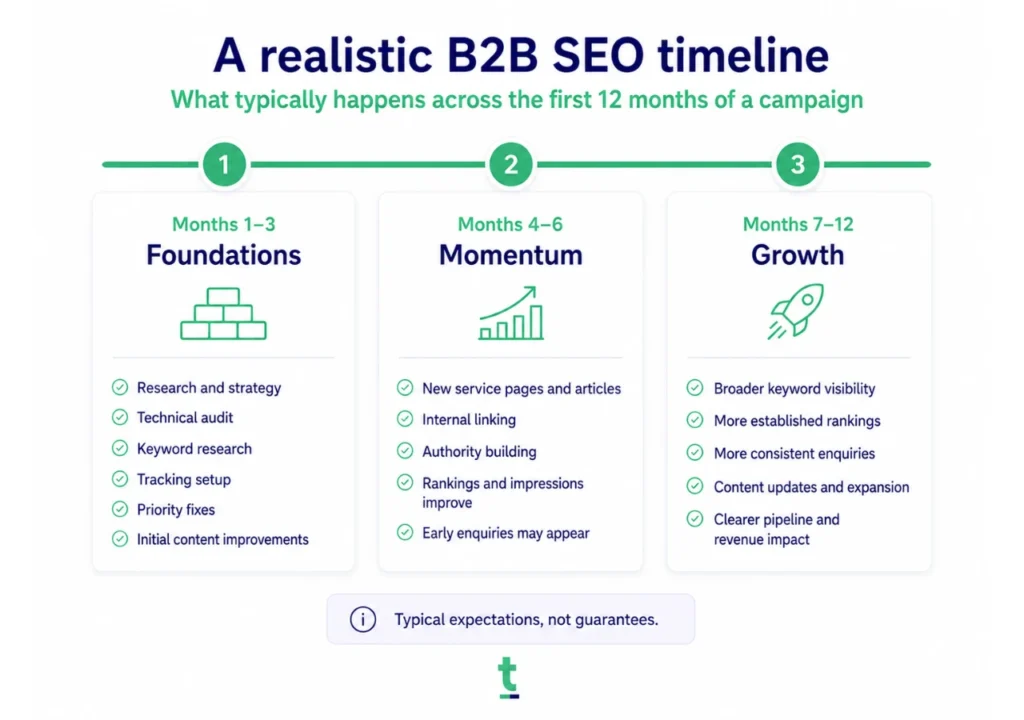
Some businesses move faster, others take longer, but it is a much more realistic expectation than “page one in 30 days”.
So, how long does B2B SEO take?
You may see early movement within the first few months, but meaningful improvements in visibility often take around three to six months. More consistent enquiries and commercial outcomes may take six to twelve months, or longer in competitive markets.
The exact timescale depends on:
- Your starting point.
- Your competitors.
- Your website authority.
- Your content.
- Your investment.
- Your implementation speed.
- Your sales cycle.
The most important thing is to know what progress should look like at each stage. SEO should not feel like sending money into a black hole and hoping something happens eventually. You should understand what is being worked on, why it matters and whether the right indicators are moving. And remember: the goal is not simply to make a graph rise. Instead, it is to help more of the right people discover your business, trust your expertise and eventually get in touch.
For a specialist B2B company, one qualified enquiry can be worth far more than thousands of irrelevant visits.
If your business needs ongoing strategy and implementation, our B2B SEO services combine commercial page optimisation, technical SEO, expert-led content, internal linking and authority building within a managed campaign.
If you already have an internal team that can deliver the work, our SEO consultancy service provides strategic direction, audits and expert oversight without duplicating the skills you already have.
Frequently asked questions
Can SEO generate results in one month?
SEO can produce early improvements, particularly when a website has technical problems or pages that are already close to ranking. However, one month is rarely enough to judge the success of a full B2B SEO campaign.
Why does B2B SEO often take longer?
B2B markets may have strong competition, specialist audiences and longer buying journeys.Several people may also be involved in the decision, which means the time between first visit and final sale can be substantial.
When should I expect my first organic enquiry?
An enquiry could appear within the first few months, but there is no guaranteed point.The timing depends on your existing visibility, website quality, competition, search demand and sales process.
Does a larger SEO budget produce faster results?
A larger budget can allow more work to happen at the same time. It cannot guarantee rankings or remove the time needed for search engines and buyers to respond.
How much time will our internal team need to give an SEO agency?
There is no fixed amount.
A managed campaign should not require your team to perform the agency’s work, but some internal input is usually essential.
You may need to provide:
- Commercial priorities.
- Subject-matter interviews.
- Technical clarification.
- Case studies.
- Content approvals.
- Access to data or systems.
- Feedback on enquiry quality.
The amount of time required depends on the complexity of your services and how much expertise already exists inside the agency.
A good provider should organise this input efficiently so that specialists contribute knowledge without becoming responsible for delivering the campaign themselves.
Should I stop SEO after six months if there are no sales?
Not automatically. Review whether visibility, relevant traffic and qualified enquiries are improving.You should also consider your sales cycle and whether the correct work has been implemented. However, the agency should be able to explain the progress clearly and adapt the strategy where necessary.
How long should a B2B company invest in SEO?
SEO works best as an ongoing activity. A six- to twelve-month period usually provides a more realistic opportunity to build visibility, learn from performance data and connect activity to commercial results. We often have businesses contact us because they have lost visibility. Most of the time, this is because they have not kept up with their SEO. SEO needs to be baked into the normal marketing activities, as the value compounds over time.
If you are ready to move from researching timelines to building a campaign, our Birmingham SEO services combine strategy, content, technical SEO and authority building around the commercial searches that matter to your business.