

B2B SEO costs UK: Pricing, packages and what to expect
SEO
Key takeaways
- UK B2B SEO retainers can range from a few hundred pounds to £5,000 or more per month.
- A lower price normally means less implementation capacity, fewer content assets or a narrower scope.
- Two agencies charging the same amount may include very different work.
- The right budget depends on your market, website condition, competition, internal resources and growth ambitions.
- Established B2B companies should assess SEO by qualified enquiries, pipeline and revenue—not traffic alone.
- A small campaign can work, but only when its pace matches the size of the opportunity.
- The most useful question is not simply “What does SEO cost?” but “What can realistically be achieved with this level of investment?”
How much does SEO cost?
It sounds like a simple question; unfortunately, the answer often seems to be anything but.
You visit an agency website and find lots of talk about bespoke strategies, tailored solutions and transformational growth, but no actual prices. Then you book a call, sit through a presentation and wait until the end before someone finally tells you whether the service costs £500 or £5,000 a month.
It can be very frustrating.
We understand why agencies sometimes hide their prices. Every website, market and business is different. A small consultancy trying to improve its local visibility does not need the same level of support as a national company competing against well-established brands. But that does not mean pricing needs to be a complete mystery. Committing to a definite price on your website isn’t always possible.
So, how much do B2B SEO services cost in the UK?
There are so many factors that go into this that we’ll need to break it down.
Who is this pricing guide for?
This guide is intended for marketing managers, directors and established service businesses considering professional SEO support.
It will be particularly useful if:
- You are comparing agency proposals.
- You need to build an internal business case for SEO.
- You are deciding between a managed campaign and consultancy.
- Your services have meaningful contract or lifetime value.
- Your market is specialist, technical or competitive.
- You want to understand what different levels of investment can realistically achieve.
Very small businesses or sole traders may find that a focused project, training or consultancy provides a more suitable starting point than a full managed campaign.
What does B2B SEO normally cost?
Most UK SEO services are priced in one of three ways:
- A monthly retainer.
- A one-off project fee.
- An hourly or daily consultancy rate.
For businesses that want consistent growth, a monthly retainer is the most common option. That is because SEO is not usually a one-off job. Your website may need technical improvements, new service pages, ongoing content, backlink building, reporting and regular changes as your competitors and search results develop.
But, from a small digital marketing agency, a broad guide might look something like this:
| Monthly budget | What it may realistically support | Typical limitation |
|---|---|---|
| Under £500 | Limited consultancy, monitoring or a narrowly defined task | Usually insufficient for ongoing strategy, content and implementation |
| £500–£1,500 | Foundational activity for a focused or less competitive business | Progress may be gradual, and priorities must be tightly controlled |
| £1,500–£3,000 | Active managed campaign with regular content, implementation and authority building | May still require client input or internal technical support |
| £3,000–£5,000+ | Multi-stream campaign across content, technical SEO, digital PR and several commercial priorities | Requires strong internal collaboration and clear commercial goals |
These are broad market ranges rather than fixed rules. Always compare the scope, experience and implementation capacity behind the price. For example, two different agencies may charge the same amount while providing very different levels of work. One may include strategy, content writing, technical implementation and link building. Another may provide a monthly report and a list of tasks for your team to complete.

The difference between these price bands is not simply the number on the invoice. A larger budget usually increases the amount of experienced time, implementation capacity and strategic activity available each month.
This is why the monthly figure only tells you part of the story. The more useful question is: What will actually be done for that investment?
What a larger SEO budget actually buys
A larger SEO budget should not buy guaranteed rankings.
It should buy more experienced time, greater implementation capacity and the ability to progress several parts of the strategy at once.
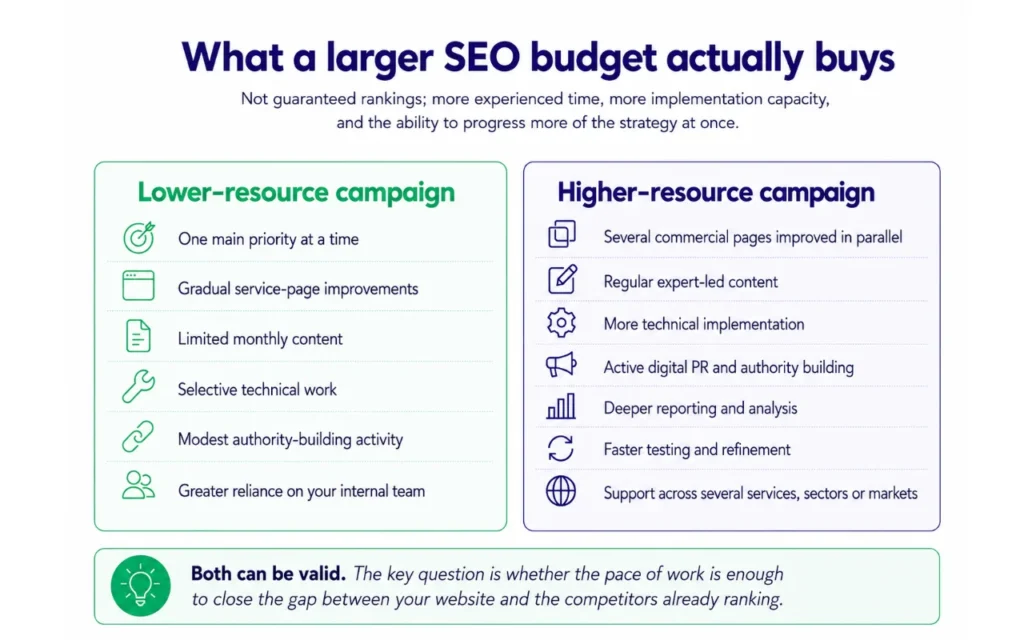
Both approaches can be valid. The important question is whether the available pace of work is enough to close the gap between your website and the competitors already ranking.
Why very cheap SEO deserves careful scrutiny
A low price does not automatically mean that an SEO service is poor.
A freelancer with low overheads may provide excellent specialist advice. A limited consultancy arrangement may also be entirely appropriate for a business that can implement the work internally.
Instead, the concern should arise when a provider promises a full managed service for a fee that cannot realistically cover the time required.
To deliver useful B2B SEO, somebody normally needs to:
- Understand the business and market.
- Research search demand and competitors.
- Review technical issues.
- Plan or improve commercial pages.
- Create and edit content.
- Capture subject-matter expertise.
- Build relevant authority.
- Implement recommendations.
- Track performance.
- Explain what should happen next.
If all of that is supposedly included for a very small monthly fee, ask how the provider is making the numbers work.
Possible warning signs of a potentially poor SEO service include:
- Generic content produced with little expert input.
- Large volumes of unedited AI-generated copy.
- Bulk link packages.
- Automated reports with little interpretation.
- Recommendations that the client must implement alone.
- Junior delivery with limited senior oversight.
- The same strategy being used for every client.
- Important activities being excluded from the headline fee.
The issue is not cheapness in isolation. It is whether the scope, skill and time available are sufficient for the result you expect. We provide a handy checklist for assessing SEO providers here.
Why do SEO prices vary so much?
SEO is not one single activity. It is a combination of strategy, research, technical work, content, digital PR, link building, implementation and measurement. The price depends on how much of that work your business needs.
1. The condition of your website
Some websites already have strong foundations. They are technically healthy, contain useful content and have a clear structure. They may only need a sharper strategy and consistent ongoing activity.
Other websites need much more work. They may have poor page structures, thin service content, technical errors, and weak internal linking and confusing messaging, to name but a few problems we see when meeting a new client.
If your website needs substantial repair before it can compete, the initial investment is likely to be higher.
Think of it a little like renovating a house: adding a new coat of paint is relatively straightforward, but fixing the foundations, rewiring the building and replacing the roof is a different job entirely.
2. The level of competition
SEO is competitive.
You are not working in isolation. You are trying to become more visible than the other businesses already appearing in the search results.
If your competitors have invested in SEO for several years, they may have hundreds of well-written pages and strong backlink profiles – two key components for a high-ranking website.
Closing that gap takes time and resources.
A local specialist competing with a handful of similar businesses may need a relatively modest campaign, whereas a national company targeting highly valuable commercial searches may need a much more intensive one.
3. The value of your keywords
Some keywords are more commercially valuable than others.
A phrase that could lead to a £50 purchase will attract one level of competition, but a phrase that could lead to a £50,000 contract is likely to attract another.
Businesses are usually willing to invest more to rank for searches that could produce significant revenue, but that does not mean you should blindly chase the most competitive keywords.
There may be smaller, more specific opportunities that are easier to win and more relevant to your ideal clients (especially in the world of B2B).
But the potential value of the market will still affect the level of competition.
4. How much content you need
Content is a major part of most B2B SEO campaigns.
You may need:
- New service pages
- Sector-specific landing pages
- Blog posts
- Case studies
- Lead magnets
- Comparison guides
- Frequently asked questions
- Email campaigns
- Digital PR assets
Some businesses already have people who can create this content internally, whereas others need the agency to interview their experts, plan the content, write it, edit it and upload it. We work with both kinds of clients, and naturally, the second option requires more resources.
The complexity matters too. A short article about a familiar topic is different from a detailed technical page that requires research, interviews and several rounds of approval.
When comparing SEO packages, check what the agency means by “content”.
Does one piece mean a short blog post or a 3,000-word guide? Are interviews included? Does the agency upload the content?
The detail matters and can affect pricing.
5. How quickly you want to progress
More investment does not guarantee instant results. SEO is a medium- to long-term channel and takes time.
But a larger budget can allow more work to happen at once.
For example, a smaller campaign may create two pieces of content each month while steadily improving the website. Whereas a larger campaign may create several pages, run digital PR activity, build links and address technical issues at the same time.
Both approaches can work. The difference is the speed and scale of implementation.
This is why SEO pricing should reflect your ambitions.
If you want gradual, sustainable progress, you may not need the largest package. If you are entering a competitive market and need to close a significant gap, a small campaign may simply not have enough resources behind it.
What should a B2B SEO service include?
An SEO retainer should be more than a monthly report telling you whether your rankings moved up or down.
The exact activities will vary, but a credible service may include the following.
Strategy
Before work begins, the agency should understand:
- Your commercial goals.
- Your priority services.
- Your ideal clients.
- Your sales process.
- Your market.
- Your competitors.
- Your internal resources.
Without this, SEO can quickly become a collection of disconnected tasks. You may gain more traffic without gaining more useful enquiries.
Keyword and search-intent research
Keyword research should identify more than popular search terms.
It should consider:
- Who is searching.
- What they need.
- How commercially relevant the search is.
- Which page should target it.
- How difficult it may be to rank.
- What one good enquiry could be worth.
For B2B businesses, a lower-volume search can still be extremely valuable. The goal is not to attract the largest possible audience; it is to attract the right one.
Technical SEO
Technical SEO helps search engines access and understand your website.
This may involve improving website speed, correcting broken links and improving structured data (amongst other things). Sometimes a campaign requires significant technical work before you can even move on to content creation, but sometimes the website is already in good condition and only needs occasional support.
Content creation
Useful content helps your business become visible and gives potential clients a reason to trust you.
A B2B campaign may require all sorts of different types of content, from service pages to case studies to comparison guides.
But just using AI to generate content or researching your topic online won’t work the way you hope. It may be fast (and cheap), but this only leads to content that replicates what’s already out there.
Good content should reflect the real expertise within your business; it should not feel as though it could have been copied and pasted onto any competitor’s website.
Good quality content needs to include the input of industry experts (namely, your staff).
Look for agencies that use your employees as sources of information for your content.
Backlink building and digital PR
Backlinks and third-party mentions can help strengthen your website’s authority.
But the approach matters. Buying hundreds of cheap links may make a report look busy (and not take much time), but it can leave your website with a poor-quality backlink profile.
Plus, Google’s guidelines say that backlinks should not be bought; the search engine leviathan does penalise websites that it suspects have built links by buying them.
Ethical link building may involve all sorts of activities, including:
- Responding to journalist requests.
- Add websites to relevant directories.
- Requesting expert contributions.
- Creating original research.
It creates a much healthier foundation for your SEO. Watch out for agencies that are very quiet about how they create backlinks.
Tracking and reporting
You should know what work is being done and why.
For a B2B company, reporting should not stop at traffic. Where possible, it should help you understand whether SEO is contributing to qualified enquiries, opportunities and sales.
Our B2B SEO pricing
At Twogether Digital, we try to be really open about our pricing. We have three packages that we use as guide prices. These provide a clear starting point, but the work can be tailored so you are not paying for activities you do not need.
If you are specifically comparing SEO services in Birmingham, our Birmingham SEO service page brings these packages together with more detail about how we support local B2B and service businesses.
Saying hello: £800 per month
This package is designed for businesses that want to put the right foundations in place and begin building their organic visibility.
It includes:
- Two pieces of content.
- SEO strategy.
- Keyword research.
- Technical SEO as required.
- Backlink building.
- Tracking and monthly reporting.
- A virtual one-to-one meeting.
The content could include website copy, blog posts, email campaigns or lead magnets, depending on what the strategy requires.
This level may suit you when:
- You are investing in SEO for the first time.
- Your market is relatively focused.
- You want steady, sustainable progress.
- You have a modest number of priority services.
- You can support some activity internally.
- Your website already has reasonable foundations.
It is not an instant results package.
There is still real work involved, but it happens at a measured pace.
Catching up: £1,700 per month
This package is for businesses that need more momentum.
It includes:
- Four pieces of content.
- SEO strategy.
- Keyword research.
- Technical SEO as required.
- Backlink building.
- Inbound digital PR opportunities.
- Tracking and monthly reporting.
- A virtual one-to-one meeting.
This level may suit you when:
- Your competitors are already investing in SEO.
- You want to increase your market visibility.
- You have several services or audiences to target.
- You need more regular content.
- You want to build authority as well as improve your website.
- You need a more active campaign.
The additional resource allows more parts of the strategy to move forward each month.
For example, we may be able to improve service pages while also creating supporting content and building external authority.
Dominating: £4,500 per month
This is our most intensive campaign.
It includes:
- Eight pieces of content.
- SEO strategy.
- Keyword research.
- Technical SEO as required.
- Backlink building.
- Inbound digital PR opportunities.
- One outbound digital PR campaign each quarter.
- Tracking and monthly reporting.
- Virtual or in-person one-to-one meetings.
- Access to additional services such as photography, videography and Mailchimp management where needed.
This package is intended for businesses operating in highly competitive markets or aiming for more rapid progress.
It may suit you when:
- You are competing nationally.
- Your competitors have strong websites and authority.
- You have several services, sectors or locations to target.
- You need a substantial amount of content.
- You want proactive digital PR.
- SEO is a major part of your growth strategy.
- You have the capacity to manage a more active campaign.
Even at this level, SEO is not instant, but the larger investment means more strategic work can happen at the same time.
Is cheap SEO always a bad idea?
Not necessarily. A smaller business with a simple website and a narrow market may not need a large monthly campaign.
The problem is not low-cost SEO by itself; the problem is when the price does not match the promise. For example, be cautious when someone promises:
- Immediate first-page rankings.
- Hundreds of backlinks every month.
- Guaranteed top positions.
- Large volumes of content for very little money.
- Thousands of visitors with no explanation of relevance.
- A “secret” method that nobody else knows.
SEO requires skilled people and time.
Someone needs to research the market, review the data, create the strategy, fix the website, produce content and build authority.
If a package costs very little, ask how much genuine time can realistically be spent on your business.
Sometimes the answer is that the work is heavily automated, outsourced cheaply or focused on activities that are easy to report rather than useful to you.
As with most things, if it seems too good to be true, it probably is.
Should you choose a freelancer or an agency?
There is no universally right answer.
A freelancer may be a good fit when:
- You need support in one specialist area.
- You have a strong internal team.
- Your budget is limited.
- You can manage the implementation yourself.
- The project is relatively focused.
An agency may be more suitable when you need several skills working together, such as web development, design and SEO.
However, agencies vary enormously.
A large agency may offer plenty of resources, but pass your work through several account managers. A smaller specialist agency may give you more direct access to the people doing the work.
The important thing is to understand who will actually work on your campaign.
Ask:
- Who will create the strategy?
- Who will write the content?
- Who will make technical changes?
- Will I speak directly to them?
- Is the work outsourced?
- What experience do they have with B2B businesses?
You are not simply buying a list of tasks; you are choosing the people responsible for improving an important business asset.
How much should your business invest?
Start by looking at the value of a good client.
Let’s say your average new client is worth £10,000. An £800 monthly campaign costs £9,600 over a year. If it contributes to one suitable new client, the direct revenue may broadly cover the investment. If it creates several long-term client relationships, the return could be much higher.
That does not mean SEO can guarantee a certain number of clients; it cannot, and you should run a mile if someone guarantees anything in this field!
But looking at customer value helps put the cost in context. SEO is often most valuable to businesses where one qualified enquiry is worth a significant amount. This is one reason it can work so well for specialist B2B service companies: you do not necessarily need thousands of additional visitors; you need more of the right people to find you.
How long should you invest for?
SEO needs enough time to work.
We offer three-, six- and twelve-month contract choices because different businesses have different levels of confidence and commitment.
However, it is important to be realistic.
A three-month campaign may provide useful groundwork and early signs of movement. But it is less likely to show the full commercial impact of SEO, particularly in a competitive B2B market with a long sales cycle. Whilst you may start to see an effect within the first few months, stronger results often take six months or longer.
The campaign length should reflect:
- The starting condition of your website.
- The amount of work required.
- The strength of your competitors.
- The speed of implementation.
- Your sales cycle.
- Your budget.
SEO should not be treated as a quick fix for an empty sales pipeline next month. It is better viewed as an investment in creating a more dependable source of visibility and enquiries over time.
How to compare SEO proposals
When comparing providers, do not simply choose the one with the lowest monthly price or the longest list of deliverables.
Instead, ask:
- Does the agency understand our business?
- Does the strategy focus on commercially relevant searches?
- Is content included?
- Who writes it?
- Are technical changes implemented?
- How are backlinks earned?
- What will be reported?
- Can the work be adapted?
- Will we speak to the people doing it?
- What happens during the first three months?
- How will success be measured?
You should come away understanding where your money will go.
If the proposal is full of impressive language but leaves you unsure about what will actually happen, ask more questions: a good SEO provider should be able to explain the work clearly, no smoke, no mirrors, no need to pretend search engine optimisation is some mysterious dark art.
So, what should B2B SEO cost?
There is no perfect monthly price for every business.
A smaller company beginning its SEO journey may be well served by an £800 monthly campaign. A business competing against established rivals may need something closer to £1,700. A national organisation with ambitious targets and a demanding market may need to invest £4,500 or more.
The important thing is that the investment matches your goals, the value of a new client and the speed with which you want to progress.
Good SEO is not cheap because it requires time, expertise and consistent work, but expensive SEO is not automatically good either.
The value comes from having the right work carried out by people who understand your business, and being able to see how that work supports your wider goals.
Most importantly, do not judge the value of SEO by how many visitors it produces.
For a specialist B2B business, a small number of qualified enquiries can be worth far more than a large amount of irrelevant traffic. You can explore our current packages on our SEO services for B2B businesses page.
Frequently asked questions
How much should a small business spend on SEO?
It depends on the market and the work required, but smaller businesses often begin with a focused campaign or a combination of one-off support and consultancy. The budget still needs to allow enough time for meaningful strategy, content and implementation.
Is £800 per month enough for SEO?
It can be. For a business with a focused market, reasonable website foundations and realistic expectations, £800 per month can support steady progress. It is unlikely to provide the same pace or volume of activity as a larger campaign.
Why do some SEO agencies charge thousands per month?
Larger retainers usually provide more capacity. This may include more content, technical implementation, digital PR, link building, research and strategic support. Higher prices may also reflect greater competition or the need to target several services, sectors or locations.
Can I pay for SEO as a one-off project?
Yes. One-off audits, keyword research, technical fixes and content projects can all be useful. However, SEO performance still needs ongoing attention because competitors, search behaviour and your own website will continue to change.
How quickly should I expect results?
Some improvements may become visible within a few months, but meaningful commercial results often take six months or longer. Timescales vary according to the website, competition, investment and sales cycle.
Is SEO worth the cost for a B2B business?
It can be, particularly when one qualified enquiry has significant value. The key is to target commercially relevant searches and measure lead quality, opportunities and revenue rather than traffic alone.