

How to get the best ROI from your SEO, the fastest.
SEO
Key takeaways
To get the best ROI out of your SEO, always prioritise the content that you are going to improve. Improving the rank of your content from position 5 to position 3 will give a better ROI than moving from page 3 to page 2 on the results.
You also need to spend time measuring the quality of your content against that of your competitors’ to make sure it surpasses theirs.
You will need to reverse engineer the backlink profile of the content that is ranking number 1 for that keyword and aim to replicate it.
You need results – and fast.
Everyone has felt that pressure to prove impact. Although we can all submit lists of the activities we’ve performed to reach our professional KPIs or business goals, what we really want is to show impact as quickly as possible.
Not only does it help our superiors trust us, but it’s also good for our self-confidence!
But SEO, by its very nature, takes time to implement and as such it’s often difficult to attribute the progress to one particular action.
So, what SEO activities will bring the biggest impact the fastest?
Here we look at some of the onsite content activities that you can implement on your website that will bring you the best ROI in the shortest possible time.
Caveats, caveats
I’m going to focus on informational content (the type you would normally add to a blog|) in this article. There are a couple of reasons for this…
- I have no idea what industry you’re in. You could be selling everyday products or an obscure service that the general public has no idea exists. I don’t want to give generic advice that might not be suitable for your niche.
- Advice for improving the ranking of your informational content is universal.
- Once users land on your (hopefully) better-ranking informational content, you can move them to your sales pages and in doing so, generate enquiries.
Before you start…
With all of these activities, there will be certain things that you will need in place to ensure the best chance of success.
Know your keyword strategy
Firstly, you will need to have a list of informational long-tail keywords that are associated with your niche.
An example of such a keyword is “how do I write a blog post” or “best blog post writing tips”. The user is looking for information (hence the label, “informational”).
If you’re not sure how to conduct keyword research check out our handy how-to guide to keyword research.
Track your rankings
You will need to be tracking how well your content is ranking for your targeted keywords. This is normally done in an SEO tool, such as Semrush or Ahrefs.
Have informational content on your site.
I’m also presuming you have a big body of informational content on your website. If you don’t, you will need to build a big library of content that is based on longtail keyword research.
Be actively building backlinks to your website.
You’ll also need to be actively seeking to build backlinks to your website. Backlinks are little votes of authority to the search engine giants. They show that your domain has useful content on it.
There are loads of ways to build backlinks. If you’re not sure how to do backlink building, then a great way to start is to set up profiles with the following platforms:
- Qwoted (you get a helpful round-up of requests sent through to your inbox)
- Featured
- Ranking Racoon (you can chat with other website owners and arrange to build backlinks. A great way to do backlink building)
- Sourcebottle
- Help a B2B Writer (great if you’re a B2B business)
You can then search through the requests and respond to those you think are relevant.
How to improve the quality of your content
A lot of the tips we’re going to talk about below require you to update the content on the page you’re looking at.
A great way to ensure you’re content is meeting (and surpassing) that of your competition is to look at the best-performing content on the web for the keyword that you’re attempting to rank for.
Here’s how to check the quality of your website content:
- Using your browser, open an incognito window and perform a Google search for each of the target keywords—this will show you the best-ranking content for your target keyword or, in other words, the content you’re competing against.
- Note down all the sub-topics, content elements and features of that piece of content.
- Ask yourself, which elements are your content missing? Or what can you add that the content ranking at no.1 doesn’t have?
- Improve the quality of your content. Some ideas on how you can do this include:
- Adding images/photographs
- Adding paragraphs that cover aspects of the topic already. What information needs to be covered?
- Adding infographics
- Adding video
- Adding diagrams/charts/tables.
- Adding social proof/testimonies
- Adding Personalised opinions from your team
So now that we’re clear on some of the basics, let’s look at what activities you can do to achieve the best results in the shortest amount of time:
Make sure the content is indexed
Firstly, you need to check that your website content has been indexed by Google. You can use Google Search Console to do this.
Head over to your Google Search Console account.
Click on “pages” under “indexing” on the menu on the left-hand side of the screen.
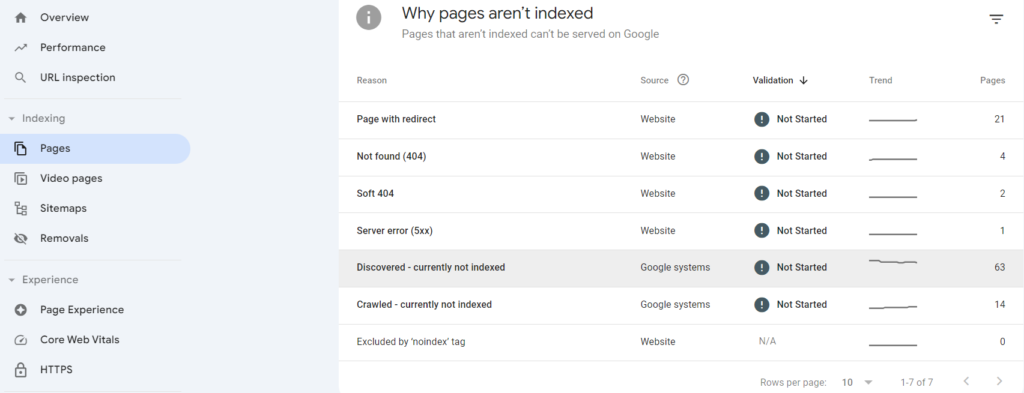
Scroll down and click “Discovered – currently not indexed”.
Scroll down and look under “examples”. Any URLs that are listed there are not currently indexed on Google.
If there are any pieces of content that you want indexed on Google, copy the URL using the clipboard symbol (it appears when you hover over the URL).

Paste the URL into the search bar at the top of the page and click “enter”. You’ll get a screen like this.
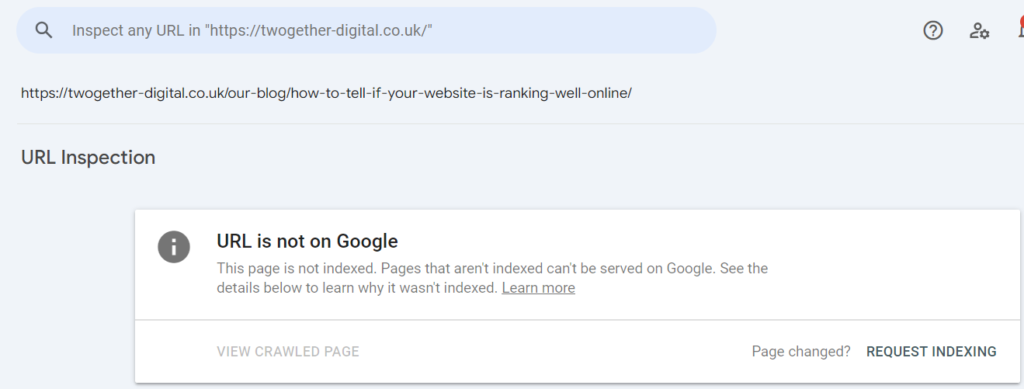
Click “request index”.
Update content on pages that have declining traffic.
- Identify the pages that have been bringing in the most organic traffic to your website 6-months ago.
- Look for those with declining traffic where you’re ranking below position 3 for any given keyword.
- Update the content on these pages following the steps above.
- Make sure that your content is optimised for search.
Update existing pages for low-hanging fruit keywords.
- Identify the keywords that you’re currently ranking 4-15 for that have a medium to search volume per month. (Depending on your niche, what you define as “medium” and “low” search volumes will vary. So, you’ll have to look at what the search volumes are for the keywords you have identified. If you’re stuck, go for 500 search volume.)
- Once you’ve identified the pages that are ranking for these keywords, update the content on these pages following the steps above.
- Make sure that your content is optimised for search.
Check your metadata quality
Identify the keywords/pages that you’re currently ranking 4-15 for. Check that the metadata for these pages is as top-notch as possible.
What is “metadata”?
The metadata is the page title and description that appears when your page appears in the search results. You can control and edit what page title and description appear by utilising an SEO plugin such as Yoast or Rankmath on your website.
You need to make sure that the keyword you’re trying to rank for appears:
- As close to the beginning of your title and description as possible.
- In both the title and description.
- In the URL (if possible).
- In the first paragraph or as close to the beginning of your content as possible.
- Three times throughout your content (but in an authentic way – don’t be tempted to overstuff your content with your keyword or write a grammatically incorrect sentence just for the sake of squeezing it in).
- In at least one of your subheadings.
- Make your titles less click-bait-y. Google prefers straightforward information.
Free website review
Request a free review of your website worth £400. We’ll reveal opportunities to increase website traffic and conversions that lead to more enquiries.
Reverse engineer the backlinks for competing content to build backlinks.
We all know that backlinks are one of the most important factors that determine how high a piece of content is ranked.
Unfortunately, they are really hard and labour-intensive to build.
(If I’m being honest, backlink building is my least favourite aspect of SEO for this reason).
- Identify the content that is ranking at position 4-9 for an informational keyword.
- Using an incognito browser, plug that keyword into Google and find what content is ranking at no.1.
- Put that blog’s URL into an SEO tool to discover its backlink profile. I use Semrush, so I use its “backlink analytics” tool to discover what third-party websites are linking to any one page.
- Then, it’s a case of trying to find an email address for those website’s editors. You can get a handy Chrome extension that can help you do this. It will scrape each website.
- You can also search LinkedIn to potentially find the marketing manager or website editor for that company.
- Improve the quality of your own website as much as possible by following the steps above.
- Next, reach out to those website editors, offering your content as an alternative to the top 1 position. Keep it polite, light breezy and positive.
- Follow up a few days later if you’ve heard nothing.
Create pages for low-volume fruit keywords.
This might feel counter-intuitive, as we’re often trained to look for those keywords that have the best search volume.
But, if you’re in a competitive space, your competitors might be dominating all the highest volume keywords. Going for low-volume keywords (lots of ‘em) might help you guarantee traffic to your website.
Depending on your niche, what you define as “low” search volumes will vary. So, you’ll have to look at what the search volumes are for the keywords you have identified to determine “low” search volume numbers.
Make sure you target low-volume keywords that don’t share an identical intent with blog posts that your competitors are ranking well for.
What does “search intent” mean?
“Search intent” means a slightly different thing to “keyword”. Google knows that “SEO agency Birmingham” and “Birmingham SEO agency” have the same “intent” even though they are different keywords.
“How do I write an SEO-optimised blog post” or “Best blog post writing tips” have two slightly different search intents, even though they’re around the same topic (that of blog writing).
The former suggests the user wants a step-by-step guide to optimising a blog post for search engines to help it rank well, whereas the latter might be looking for help with writing engaging content that encourages users to scroll.
A good way to check is to put the keyword you think has legs into Google and see what comes up at the top. If it’s a different search intent, then you’re on to a winner.
Create a clear CTA to move your users along the sales funnel.
Once you’ve got your user landing on your informational content, what next?
If you’ve chosen long-tail keywords that a connected with your niche (e.g. they are questions that your target audience is asking as they begin to look for solutions that you might be able to provide), then it makes sense to point them to the next step in their customer journey.
What that step may be will depend on what your blog is about.
It might be that you direct them to another blog that builds on their knowledge.
Or it might be you want them to look at a case study that showcases how you solved this problem for other clients.
Whatever it is, make the step really clear (we call this a Call To Action).
How to get the best ROI from your SEO, the fastest.
None of the techniques I’ve listed above are rocket science or revolutionary. The key to ensuring you get the best ROI from your SEO is to prioritise the content you want to improve. Incremental change can often bring more users to your site.
This is because the click-through rate tails off so abruptly the further down the ranking that you go. The most recent research suggests that the first organic position can command a click-through rate of nearly 40%, twice that of position 2.
As such, moving from position 4 to 3 will bring a greater reward than from position 20 to 11, even though it’s a bigger jump.
The fastest ROI also comes about by comparing your content with that of your competitors frequently – both in terms of their backlink profile and content quality.
With these two pillars in place, you can reap the benefits of improved traffic and hopefully, enquiry rate.