
How can eCommerce SEO grow your business?
SEO
Key takeaways
- eCommerce SEO refers to all the activities involved in making sure that your website appears at the top of the search engine results page (SERP) when users are searching for your products.
- Google Shopping can help point users in the direction of your products.
- Solid keyword research is the foundation of good eCommerce SEO.
With the birth of the internet, it became much easier to find and purchase products through online retailers and marketplaces. Think Amazon, eBay, Tesco.
But with its growth, the internet became a place for smaller businesses to sell their goods and services on a scale that was not possible before.
But how can you compete with those big retailers? How can you hit the magic top three results positions on Google and secure those much converted online sales?

This is where SEO for eCommerce is vital. By its nature, eCommerce sites rely on online sales; your ability to drive potential consumers to your website will determine how successful your business is.
Before we consider the benefits of SEO for eCommerce, let’s find out more about eCommerce and what SEO for eCommerce is.
What is eCommerce?
ECommerce refers to the buying and selling of goods or services using the internet, and the transfer of money to carry out these transactions. It is often used to describe the sale of physical products online, but it can also describe any kind of commercial transaction on the internet, such as crowdfunding or the sale of services.
If your business offers any of these then it is worth understanding eCommerce SEO.
What do we mean by eCommerce SEO?
eCommerce SEO refers to all the activities involved in making sure that your website appears at the top of the search engine results page (SERP) when people are searching for your products and services. If you’re in the top three then you are more likely to draw in traffic to convert into sales.
An SEO campaign is usually built around a handful of keywords which relate to your core offering, but it can become more complex if you run a business with multiple products or services. It’s more complex but it’s not impossible to make the most of your business website using eCommerce SEO.
Getting started with eCommerce SEO
Don’t be put off eCommerce SEO – it can sound scary and it is hard work, there’s no denying it.
But done right, you will reap the rewards.
SEO for eCommerce is about optimising your website so that your potential consumers can find you. But it’s not just about being found. You also need to draw consumers in, persuade them that they can trust you, and that you have the product they want, at the best price.
Here are a few top tips.
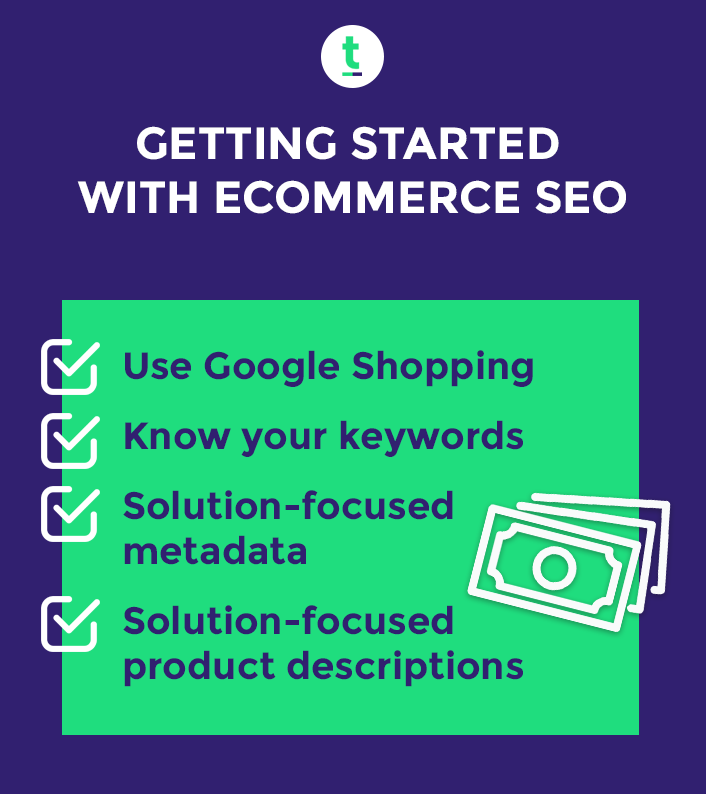
1. Use Google Shopping
If you type a product keyword into Google, chances are you won’t look at the organic search results. You are more likely to click on a tab labelled “shopping” just under the search bar on the results page in order to see lots of options from different retailers.
You can get your products listed here by creating a free Google Merchant Center Account. Once you have your account, you can add your products, ensuring Google has an inventory of all your products. Users can then click on your products and get taken through to the product page on your website.

Convert clicks to clients: The ultimate strategy to more website leads
Our free guide reveals the strategy we use for our clients to achieve long-term business growth. Interested?
2. Know your keywords
Solid keyword research is the foundation of good SEO. Keywords are the terms users type into search engines to find the products that you’re selling. You need to know what they are, so that you can write product descriptions, page copy and titles that match.
Once you’ve researched your users’ keywords, here are some ways to use them.
- Category pages need broader, shorter keywords with a high search volume.
- Product pages need to include longer keywords related to the specific product.
- When searching for an optimal keyword, you are looking for something with a high search volume, but you also want something that implies intent from the consumer which will mean you can turn a page visit into sales. This could be something like ‘review’, ‘comparison’, ‘discount’ or ‘best’. These words show the consumer is not just looking for a product, but for the best product and the best deal on that product.
- You also need to pick something relevant by thinking of how what you offer matches the keyword – only ever pick a keyword that is relevant to what you offer!
Need help with your keyword research? Let’s talk
3. Solution-focused metadata

Consumers love products that solve problems. And they often use keywords that reflect this. So, making sure that you include solution-focused keywords in your product descriptions will let search engines know that your products will help.
Let’s say you sell folding bikes – you know the type – those bikes that fold down so you can carry them on the train. And I’m a commuter. I’ve been getting fed up trying to lug my bike on to the train every morning as I journey to work. So I type in “best bikes for commuters”.
Because you’re an SEO-savvy folding bike seller, you have done your keyword research and know that this is a very high volume keyword. So, you include this keyword “Best bikes for commuters” in your meta title and meta description (meta titles and meta descriptions are bits of data that search engines use to understand what all the pages on your website are about).
If you don’t include meta descriptions, titles and data, your website won’t be telling search engines the right information about your products and users won’t be able to find them.
4. Solution-focused product descriptions
Ok, so this isn’t strictly an SEO-thing. But, to convert the user into a sale, you need to make sure the copy on your page is good.
A good opening line for your folding bike product description might be “A great solution for every commuter. Enjoy your cycle to work again with our easy-to-fold, lightweight commuter bike.”
This opening straight away tells me that this product will solve their problem of a heavy, difficult to store bike. You’re mentioning features (e.g. it’s lightweight), but you’re doing it in a way that shows why that feature solves my problem.
You’ll definitely also need to list all the features of the product, such as dimensions, cost, materials etc.
You can then add keywords into your copy to make sure your page is optimised for other keywords related to that product that users might use.
Need help with copywriting? Let’s talk.
Is SEO important for eCommerce?
Yes!
There are free tools out there that can help you sell your products, so make full use of them. But don’t overlook the importance of building an eCommerce website on solid keywords research. WIthout great SEO, your potential customers will not be able to find the products that you are wanting to sell. If you are not sending the right information to search engines, then users won’t be able to find them.